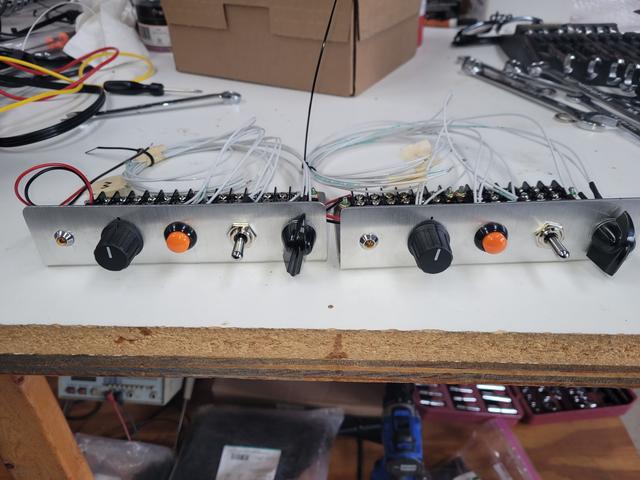
VeeCU 1.0

Wes,
I appreciate your kind & patient response.

I’m just a dumb Swede trying to understand how the formula works, and what you are trying to accomplish.

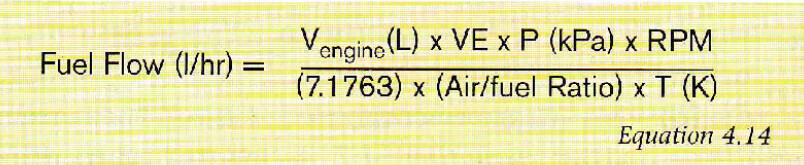
For example, a four stroke engine requires 2 revolutions to complete a cycle. Consequently, only 1/2 of the cylinders intake fuel/air per rotation. This implies that the RPM should be divided by 2 to get a total air flow volume. Since the 7.1763 constant is not defined, I can’t determine if the RPM adjustment is included or not. Furthermore, With respect to RPM and fuel flow l/hr , I don’t see a conversion factor to normalize the 2 time functions. (min. to Hours)
These may or may not be concerns, depending on what information you are trying to derive and how you are going to use the information. Unfortunately, I’m not sure what you are looking for and how you intend(ed) to use it.

With respect to your comment “ Equation 4.14 actually shows Lamda (Air/Fuel Ratio) in the denominator. I like to use ER (Fuel/Air Ratio), which is the reciprocal of Lamda", so it shows up in the numerator.” When Lamda appears in the denominator (the bottom) isn’t that the same as 1/lamda and therefore, the reciprocal of Lamda? If you prefer using ER, you should substitute the ER function for the Lambda function to retain the integrity of the equation. Your post says just need to add ER. It would be really helpful if you walk through this logic.

I may be wrong, but as I understand from your post, that VE is based on the ratio of the actual vs. theoretical values for the fuel flow. I assume that the theoretical values represent a stochiometric optimum (S.O.) and breathing issues reduce the volume of air brought in. This leads to the realization that injectors tuned to the S.O. will always be biased to run rich.
Hi John,

I’ll do the best I can to explain. Let’s back up and look at the equation again.

There are several steps before arriving at this equation. Those steps include ideal gas constants etc. All those steps are collected in the magic number (7.1763). Now, we’ve been using the term Lambda wrong up till now. Remember Lambda is the ratio of whatever Air Fuel Ratio you are running at divided by the stochiometric Air Fuel Ratio.

For gasoline(ish) fuels the stochiometric Air/Fuel ratio is approximately 14.7. If you plug 14.7 into equation 4.14 you have stochiometric fuel flow. It’s that simple.

Now peak engine power occurs at an air fuel ratio of 12.5:1 to 13.0:1. So, if you tune for peak power (peak RPM) you will be running at a Lambda of approximately 0.85. And that is why I don’t like Lambda. The more fuel you add, the smaller Lambda gets. It’s counter intuitive.

In any event, peak power is achieved at Lambda of 0.85 or an ER of approximately 1.15.

So, just run the numbers through Equation 4.14 and you have fuel flow. The only unknown is VE. It will be somewhere around 0.75. So, if I guess ER*VE of 1.0 at peak power, I’ll be close. Probably a little rich, but close. Close enough to start and run. Then set the mixture for peak power using the mixture knob, press the button, and VE can be calculated. So, there are no more unknowns.

Edit: I will add that you can lie to the system. This might be useful if you find yourself EGT limited at high power settings. That is what I was trying to illustrate in this video.

A Quick Tune Demo - YouTube

As stated earlier, the VeeCU is a semi-sequential system. That is no cam sensor. So, each injector fires each revolution applying 1/2 the fuel needed for the complete Otto cycle.

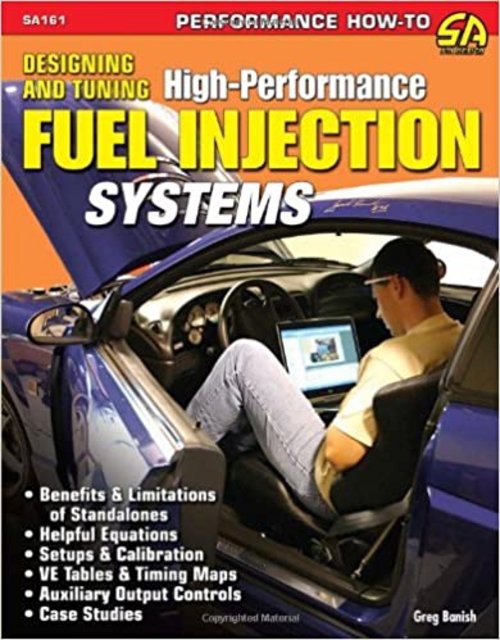
If that’s all about a clear as mud, I highly recommend this book. It’s cheap and an easy read. The best book I have found on the subject.

51-Vw6aqsdz-L-SX388-BO1-204-203-200 (1)

Wes

51-Vw6aqsdz-L-SX388-BO1-204-203-200 (1)500×640 71.8 KB

Hi Guys,

Top on my TODO list is to finalize the prime table, the cranking enrichment, and the post start enrichment. For those interested, I copied exactly what this video describes, right up to the 12:50 time of the video.

:hammer_and_wrench: How Cold Start Tuning Works | TECHNICALLY SPEAKING
Wes

Thanks Wes, That covers it.

1 Like

HI Guys,

A brief update.

As you might remember, I chose to copy this cold start enrichment scheme (How Cold Start Tuning Works). There was one thing I didn’t like about the scheme. That is that the prime pulse was given in mSec. That ties the prime pulse to a particular injector. So, I changed that to be based on the number of “cylinder fills” of fuel needed for a stochiometric mixture, at standard day IAT, and at whatever MAP you happen to be starting with.

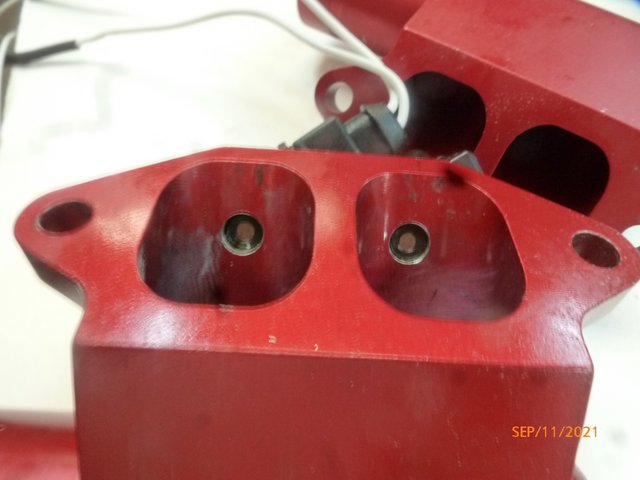
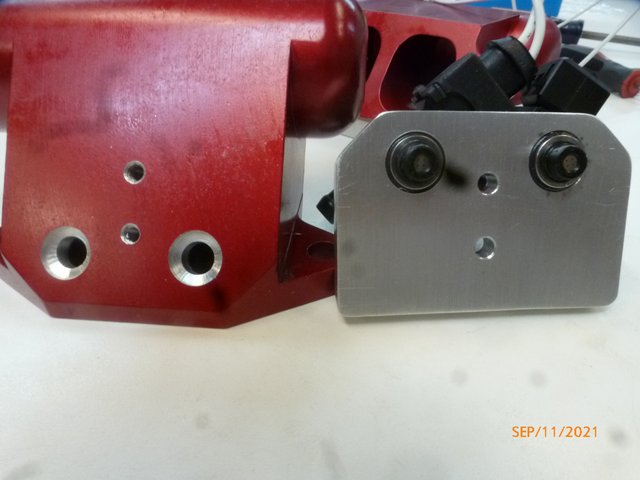
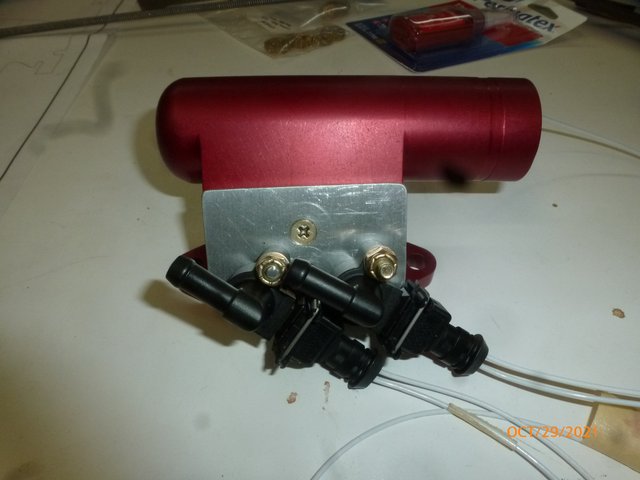
I’m getting way down the list of handled faults. The only one left is pretty obscure, but OK, I’ll deal with it. The fault is this: Backup crank sensor failed, one half of the secondary module failed. The engine will lean out and die if running on only the front two cylinders. That is because, under normal conditions, the front two cylinders scavenge much of their fuel from the rear injectors which are no longer firing. Other than that, I’ll be fine tuning the “cold start tuning” curves over the winter. There will be a considerable wait for the first “Production” units to arrive, but I have plenty to do in the meantime.

So that’s where the development sits.

I’ve been neglecting my flying lately. I need to get back to the airport, annual the Onex, and get some stick time. Once the muscle memory has been restored, I’ll bring the Onex home and start the installation.

Forever Forward,

Wes

3 Likes

Hi Guys,

Just a bit of development chatter.

Engineering prototypes are made to be broken. Hopefully at a slow enough rate that some are left when the next batch of improved boards arrive.

The next, and hopefully final, revision of the board is going out for quote soon, so it’s time to suck it up and run some potentially destructive tests.

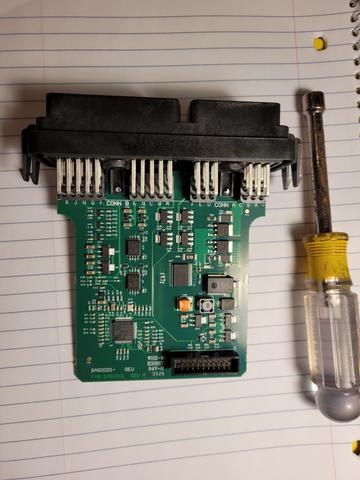
Today was the Over-Voltage test. Since the VeeCU never draws more than 100 mAmps, there is no need for switching power supplies. All of the passive regulators are rated for 50 V continuous, but I still wanted some transient voltage suppression on the front end of the power supply. I selected this one: TVS. Overkill, but peace of mind.

So, I hooked up power, set the current limit on the bench supply, turned the power supply output on and started increasing the voltage. As advertised, the TVS paid off right at 28 V and tripped the bench supply output offline.

I ran the test several times. Everything works as expected! One less thing to worry about.

BTW, cold start enrichment is going well. This will be the first Winter that I will try to get the shop as cold as possible :slight_smile:

Wes

2 Likes