Shouldn’t that be more like 3200?
Hi Brian,
Well, I can’t get that high in the shop. I’m just trying to get some rough numbers. I did just run up to 2500 and the engine ran fine with the POT set all the way up to 1.5 with very cool EGTs. That would be a lambda of about 0.6 or an ER of 1.65. The engine was running very strong. I briefly went to 2900 and still had throttle left and the EGTs were well down in the 1200s. It didn’t idle as well that rich. This is with a 46” pitch prop. on a 2180 GPAS.
I think I’ll just have to experiment once I have the system airborne. My intent is to set the TO and climb such that I stay at or below 1300 EGT at full throttle and 100 MPH. With the Hummel 2400 (cold air induction) and a 50” pitch Ptip that should be 3400 RPM and about 1000 FPM. In cruise I hope to be able to dial directly from cruise mixture to LOP without having peak the EGTs thus staying below 1300 EGT. The specified Hummel 2400 cruise is 2800 to 3200. If I could set the RPM to 3200, dial in LOP, and end up at 3000 at less than 4 GPH I’ll be a happy camper.
I can’t lie, I’m getting excited! This is going to be fun!
Wes
2 Likes
Hi Guys,
I’ve been inching forward with the VeeCU development. I’ve been abusing the prototypes to test various wiring faults. One of the faults tested today was the “Fuel Pump Relay” output. I shorted the load, for a long time, to verify that the low side driver worked as advertised. I’m happy to say it did. Current was limited to about 1/2 amp with a shorted load. BTW, the device is intended to drive inductive loads up to 7 amps. Over kill (again) but peace of mind. For those interested in such things, here is a link to the device used for all low side drivers (FP Relay Drive, Status LED, Simulated RED CUBE output). Self-Protected Low Side Driver with Temperature and Current Limit.
I removed the kludged on external components used to test the hall effect device I intend to use for the backup crank position sensor with the prototype VeeCU and replaced the prototype VeeCU with a “production” unit. Everything worked as expected.
I also shorted the ignition coil, but I only have about 11 Amp capacity on my bench supply, and the supply tripped offline as soon as the ignition activated. Per Scott Casler I have my secondary ignition fused at 10 Amps. I may up that to 15 Amps. As stated earlier, high current will only occur during cranking while dwell control isn’t possible.
I also prepared a VeeCU to install in the Onex. It has a pigtail for a debugger/programmer to enable easy viewing of real time data and making any software tweaks that might be needed.
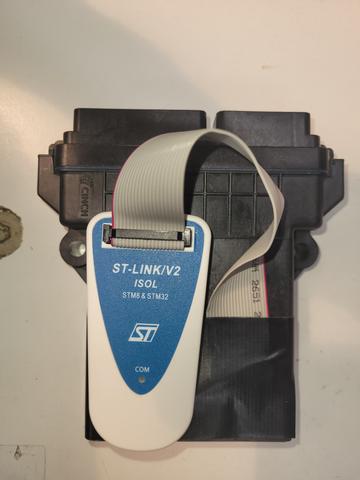
Forever Forward (slowly),
Wes
3 Likes
Hi Guys,
I’m waiting for the test engine to cool down so …
I’ve been making some last minute tweaks to the VeeCU, like having the unit report the software revision number.
I also decided to clear the test engine tune and start the tune from scratch. I’m making mental notes for inclusion in the future manual.
One thing that I didn’t expect is that with a zeroed tune the engine needs to run at over 1300 RPMs to smooth out enough for the backup crank position sensor to sync with the secondary ignition. That generates a Warning. Tuning can’t be performed with any active Warnings or Faults. So, step one will be to start the engine with the VeeCU in tune mode and allow the engine to warm up at >= 1400 RPM.
I tuned the engine all the way from 800 RPM (the lowest tune point) to 2800. At low RPMs the engine requires a lot of trim. It’s finicky down there. Once installed I will tune 800 and 900 just a little on the rich side of Max Power. I’ll tune 1000 just a little on the lean side. I’ll set my idle at 950. That way, if the engine stumbles, a little extra fuel will be available.
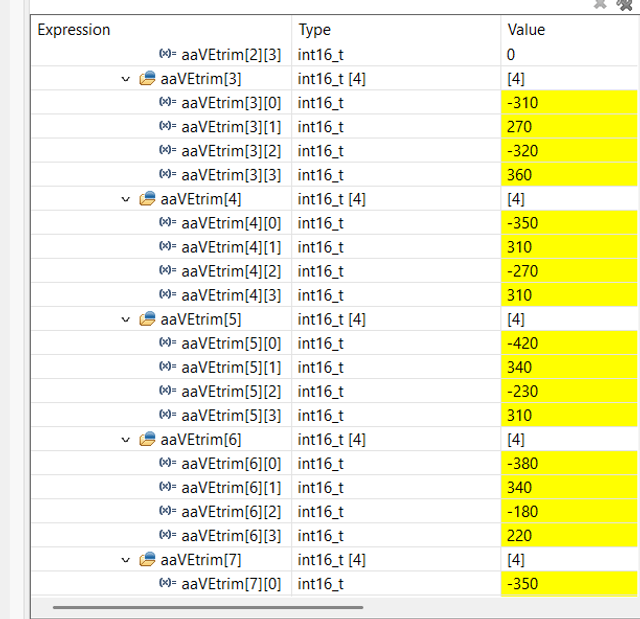
Here is a debugger screen shot of the trim numbers form 800, 900, 1000, 1100. The negative numbers represent fuel taken from the front cylinders. The positive numbers represent fuel added to the rear cylinders. Units are percent x 10.
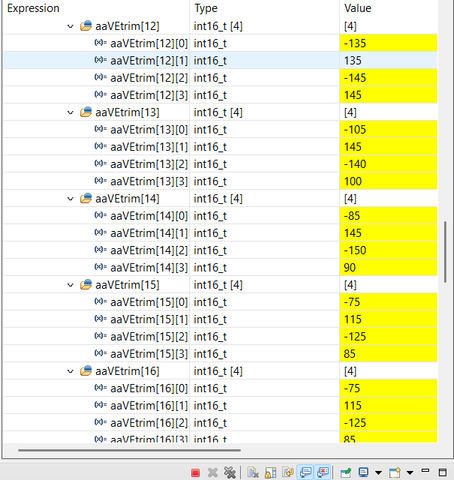
Here is a screen shot of the trim numbers for 2200, 2400, 2600, 2800, 2900. The tune points go in 100 increments from 800 to 1200, in 200 increments from 1200 to 2800, and in 100 increments from 2800 to 4000. The trim numbers come down as RPM increases. It’s very easy to tune once the engine is making power. Yor can see that the trim numbers for 2900 are identical to the trim numbers for 2800. That is because the trim numbers are propagated forward until a tune point is hit that has been previously tuned. That makes tuning easier and provides reasonable trim numbers for RPMs beyond what has been tuned (a dive?).
The engine should be cooled down now 
Wes
3 Likes
OK, I know, I’m “eat up with it”. But I’m testing every possible situation I can think of. It occurred to me that I had never tested a start with all sensors, except the crank sensor (secondary ignition module), faulted. I tested it on a cold engine, and it ran like crap until the engine was warm. That’s due to no after-start enrichment with a failed Engine Temp sensor.
Engine Temp defaulted to 400 Deg. C. That kills all warm up enrichment.
Inlet Air Temperature defaulted to 15 Deg. C.
Mix pulled to approximately 1.06 by design.
MAP estimated via lookup using tune values.
I made a crummy little video with my phone that shows a warm engine start with the faults. The Mixture fault doesn’t show because I failed the wiper. For that special case, the hardware pulls the wiper to a slightly rich setting (dirty wiper?). With MAP faulted the VeeCU estimates MAP by interpolating the MAP values that were stored during tunning.
One surprise. I expected the engine to lean out and die when I goosed the engine near the end of the video. That’s because a fast change in actual MAP doesn’t allow the engine time to speed up and “look up” the new map value. What happened is the engine bounced off the “hidden” tune point at 0 RPM which has an estimated MAP of 1000 mBar. Anyway, all great fun.
Here is a link to the video: Warm start with all sensors except primary crank sensor faulted.
Wes
2 Likes

How about now?
1 Like
It’s good. I like the Harley mode near the end.
1 Like
I just realized that the Harley sound is not just due to the 1000 mBar 0 RPM MAP estimate. As the engine tries to die, and approaches the 1000 mBar point, the rapid increase in MAP triggers the Accel Pump function. You can see the results if you watch the On Times as it starts to die. It used to die using the same method before the AP function was added (a long time ago).
Wes
1 Like