Y tail angle
Posted: Fri Mar 06, 2020 4:27 pm
by Carlos Trigo
Guys
I am building the XENOS tail, and to install the Total Energy multi-function probe I need to know the angle that the tail surfaces make with the horizontal plane.
Does anybody know this angle?
Is it around 45º?
Thanks
Carlos
Re: Y tail angle
Posted: Fri Mar 06, 2020 5:05 pm
by XenosN42
I installed my total energy probe as shown in this image of the last rib on the stabilator:
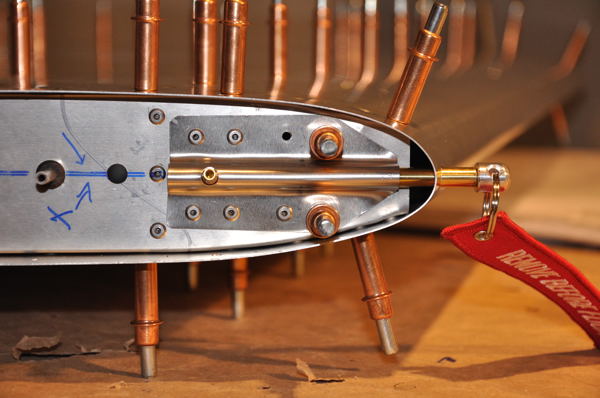
Installed this way the probe points directly into the airflow. I don’t know the angle the tail surface makes with the horizontal plane, but I don’t think it makes a difference. Just install as the image shows and you’ll be great to go.
Y tail angle
Posted: Fri Mar 06, 2020 6:29 pm
by Carlos Trigo
Hi Xenos42
Thanks for your answer and the picture of your installation.
The manufacturer of the multi-function (pitot + static + TE) probe recommends to install the probe and its adapter with the 3 pressure ports in a vertical position, pointing upwards.
That’s the reason I want to install the adapter in the same place you installed yours, but with the barbed ports (3 in my case) clocking vertically when the tail surface is installed in its Y angled position.
Carlos
Re: Y tail angle
Posted: Fri Mar 06, 2020 7:05 pm
by Area 51%
If the Xenos is the same as the Waiex, the stabilizers are 35deg from horizontal. If you have the Y fitting that attaches to the tail post, you can get your information from that.
Re: Y tail angle
Posted: Fri Mar 06, 2020 9:13 pm
by Bryan Cotton
The 3 view on the plans is a good place to measure the angle. The plans are drawn in AutoCAD so the picture is accurate. I measured it once for my Waiex but don’t know the number, but of course Randy just gave it.
Y tail angle
Posted: Sat Mar 07, 2020 6:23 am
by Carlos Trigo
Thanks guys
Carlos
Enviado do meu iPhone usando o Tapatalk
Y tail angle
Posted: Sun Mar 08, 2020 12:02 pm
by Carlos Trigo
Following Bryan’s suggestion, I measured the angle in the 3-view drawing, and it gave me 38º
Carlos
Re: Y tail angle
Posted: Sun Mar 08, 2020 3:32 pm
by Area 51%
Not that 3deg is a lot, but just out of curiosity, did you measure the angle of the front spar on the print, or the rear? And on what page?
The reason I ask is I just measured the angles on my Waiex print (page T-07) and got two different readings. The rear Y came to 110deg. The front (hockey sticks) showed 104-105ish. Take those, subtract from 180, divide by two, and you get both answers. 35 and 38.
Now, I don’t believe there is a twist built into the tail. What I do believe is the picture of the front attach point on T-07 is more of a rendering than a print. I think the amount that the hockey sticks angle rearward causes an “apparent” angle on that page.
For what it’s worth, when I gave the 35deg measurement, it was on the airplane with a digital level.
On the other hand…the Xenos might be different.
Bored and curious here @Area 51%
Y tail angle
Posted: Sun Mar 08, 2020 7:56 pm
by Carlos Trigo
Hello Area51%
I measured it on page XNS-B01, but in fact these 3 degrees are not relevant for this case.
So, thanks anyway
Cheers
Carlos
Re: Y tail angle
Posted: Mon Mar 09, 2020 12:30 pm
by racaldwell
Carlos,
I guess you have a fixed probe? I just thought they were all like the one I bought, it is removable. I am thinking it can be clocked in any way. I remember it has o-rings on the end but don’t remember if was keyed. It’s been too many years since working on the tail. I haven’t looked at the probe since then.
Rick Caldwell
Xenos 0057
Y tail angle
Posted: Mon Mar 09, 2020 1:31 pm
by Carlos Trigo
racaldwell wrote:Carlos,
I guess you have a fixed probe? I just thought they were all like the one I bought, it is removable. I am thinking it can be clocked in any way. I remember it has o-rings on the end but don’t remember if was keyed. It’s been too many years since working on the tail. I haven’t looked at the probe since then.
Rick Caldwell
Xenos 0057
Hi Rick
No, I have a removable probe as well.
The manufacturer (ESA Systems) recommends that the probe be used always with the TE sensor pointing upwards.
Further, they also recommend that the adapter (the female piece, installed solid inside the stabilator) be installed with the 3 barbed ports pointing upwards, like this
https://www.esa-systems.com/fileadmin/u … einbau.jpg

That is the reason why I wanted to know the angle of the stabilator with the horizontal, exactly to clock the position of the adapter which is to be rigidly installed inside the stabilator.
Problem solved!
Thanks
Carlos
Re: Y tail angle
Posted: Tue Mar 10, 2020 5:48 am
by XenosN42
Carlos Trigo wrote:No, I have a removable probe as well.
The manufacturer (ESA Systems) recommends that the probe be used always with the TE sensor pointing upwards.Further, they also recommend that the adapter (the female piece, installed solid inside the stabilator) be installed with the 3 barbed ports pointing upwards, like this
https://www.esa-systems.com/fileadmin/u … einbau.jpg
That is the reason why I wanted to know the angle of the stabilator with the horizontal, exactly to clock the position of the adapter which is to be rigidly installed inside the stabilator.
Problem solved!
Thanks
Carlos
Hey Carlos,
When I was researching TE/pitot/static probes I called one of the better known aviation shops specializing in soaring. I asked for the type of combination TE/pitot/static probe you are using. Their response: “Well we’ll sell you that if the plans demand it, but we don’t recommend it.” Why? Those combo probes have very small O rings inside to separate the air flows. IF one of the O rings comes dislodged it might be necessary to REMOVE the probe mount to fix or replace it. Not a fun prospect. I then decided to buy a separate pitot tube (installed in right stabilator) and a separate TE probe (installed in the left stabilator). The static ports were installed on the fuselage sides.
By the way, do you know why they want the probe’s barbs to be mounted in a vertical orientation? It all about moisture. If any liquid (rain) enters the probe it will need to travel straight uphill, which it is less likely to do, before entering the tubing which is now running downhill towards your expensive instruments. In my installation the barbs are pointing up enough to keep liquids from entering the tubing (it doesn’t need to be straight up).
Re: Y tail angle
Posted: Fri Feb 12, 2021 4:35 pm
by Xenos59-1/2
On our E-Xenos, we installed the 3-port pitot/static/total-energy probe on the tip of the right stabilizer.
Might have been this one, or something similar:
https://www.esa-systems.com/en/products … -mnicun-1/
Unfortunately, it has proven to be very sensitive to yaw. When oriented with the TE side arm straight up, as recommended, it indicated 500 fpm lift in a left yaw, and 300 fpm sink when yawing right. After testing all orientations, we settled on orienting it 45 degrees left of up, or in-and-up. It is still yaw sensitive but the vario is somewhat usable now.
Re: Y tail angle
Posted: Sat Feb 13, 2021 3:28 am
by NWade
All - TE probes tend to be yaw-sensitive because they use holes drilled on the aft-facing side of the tube and rely on airflow around the tube to create a Venturi effect where the holes are (since TE compensation is usually achieved through the use of a calibrated amount of suction).
When you yaw, you change the relative angle of the wind on the probe, shifting the low-pressure-zone on the back side of the tube to the left or right. Some TE probes use an array of holes to reduce this yaw sensitivity, but they remain less reliable in a slip or skid.
If the probe is too short, it may actually be the flow-field around the stabilizer that is causing those unwanted readings. Given the angled orientation of the “Y” tail stabilizers, that dovetails nicely with the orientation you found to provide more-accurate readings - as that orientation displaces it farther from the extended centerline of the stabilizer chord.
—Noel
(Who’s used the multi-probe system on a couple of sailplanes for several years with no o-ring problems)