Voltage Regulator Failures
Posted: Fri May 29, 2015 12:09 pm
by Daviator
Anyone had voltage regulator failures on their Jab 3300? I have had two fail on me in less that 2 hours of flight time and before I risk another one I would like to know if this could possibly be an indication of something else wrong. The original regulator was on the plane for over 250 hours of flight but the second one went bad after only about an hour. I’ve checked my wiring several times and had a knowledgeable friend look at it also but we can’t see anything wrong.
Re: Voltage Regulator Failures
Posted: Fri May 29, 2015 7:15 pm
by pepperdoug
My original lasted (sorry, going by memory here as I just sold my plane) about 250 hours. My second less than 15 hours. My third is still in service after another 200 hours.
The second was replaced without charge. Funny thing was I ordered another one (generic and a lot cheaper) off the Internet as a spare and installed it before the warranty replacement came. So now, I have a good one sitting around with no airplane.
Also, the first failure was catastrophic. While on a short flight I smelled something electrical. I shut down the Master and landed within 15 minutes. The failed unit had burned a small hole in my firewall where it is mounted. That was interesting! The back of the unit was melted and looked as if it shorted itself out internally.
The second unit failed but just quit working.
As a side note…and this is purely subjective and unsubstantiated or documented…I had noticed odd behavior in my EIS system, such as odd outside air temps and fluctuating EGT temps for a long time before eventual voltage reg failure. Since these symptoms disappeared after replacement, I assume it was the regulator causing the odd instrument behavior.
Re: Voltage Regulator Failures
Posted: Fri May 29, 2015 9:43 pm
by fastj22
Interesting symptoms. I was experiencing some erratic readings on my senders too and they magically stabilized recently. I wonder if my regulator is blinking out on me. Might be a good time to order a spare and have it ready to swap. I found the Kubota replacement on Amazon for $28.
Re: Voltage Regulator Failures
Posted: Sat May 30, 2015 11:36 am
by ldmill
My first thought on this is that you may have an intermittent grounding or power issue. Most EFIS and radio’s are able to ride through short moments of loss of power (10-50 milli-seconds) and voltage surges without a restart - so you have no specific visual indicator of momentary power loss. However, cycling power like this will eventually lead to issues somewhere due to the voltage spikes that accompany it. My suggestion would be to start looking at ground/power cables & wires and make sure they are clean.
My own experience on this cost me a pocket full of greenbacks. My Jeep blew multiple expensive electrical thingies over a short period of time before we finally traced it back to a ground cable connection at the battery that was slightly loose and moderately corroded.
Lorin Miller
Re: Voltage Regulator Failures
Posted: Sat May 30, 2015 4:30 pm
by DCASonex
Suspect you have a problem somewhere, Have a bit over 200 hours on mine (combined total with Jabiru and CAMit engines). Do have a cooling air jet directed at it, and it is mounted on a SS plate raised about 1/4" from FW in case it decides to burn up. Cooling fins are oriented vertical for best air flow. I pop off the cowl’s oil filler cover to let out heat on landing. Had stablemate for a while with same 3300 and and his only lasted 5 hours. ??? If you have not already done so, replace those undersized spade lug connectors that came on the alternator. Any GOOD quality ones of same size will suffice. Poor connections can cause untold problems, not just burned wires and lack of charging.
David A.
Re: Voltage Regulator Failures
Posted: Mon Jun 08, 2015 5:40 pm
by Daviator
Update on the Voltage Regulator:
Executive summary - Don’t buy cheap Chinese made regulators, stick with the Kubota brand, made in Japan, original equipment. If you want more detail keep reading.
I decided to replace my voltage regulator after I noticed the peak voltage while the engine was running was starting to creep up to voltages that I thought were not safe for operation. Turns out that the Odyssey PC625 battery has a voltage rating of 14.7 volts when charging and can even go as high as 14.8. This was my first mistake that started a domino effect of failures. I purchased a voltage regulator online for a price that was significantly less than what I was quoted by Jabiru USA. I installed this voltage regulator and flew for approximately 30 hours before I noticed that the battery was not able to crank the engine on a cold start up like it had done previously. I purchased a trickle charger and the problem seem to have disappeared, the weather was getting warmer and the charger kept the battery well maintained. After about another 10 hours the new voltage regulator quit working. Now I started to suspect an alternator problem and so i purchased and installed another regulator. This regulator (#3) quit after only about an hour of flight. Now I started to dig into things much deeper, investigating the battery specifications, regulator specification, and alternator specifications which included a conversation with Pete at Jabiru USA. I came to the conclusion that the problem was most likely the aftermarket regulators that I had been using. I have now installed an original Kubota RP201-53710 regulator and my problems (perceived or true) have gone away.
Things to remember:
- Seeing 14.7 volts while the engine is running is acceptable for the Odyssey PC625 battery
- The Jabiru 3300 alternator is rated at 20 amps but has a peek output of 32 amps
- Get educated on the specifications of the parts you are replacing before replacing them.
Re: Voltage Regulator Failures
Posted: Tue May 03, 2016 11:11 am
by Boat
I thought I had a problem with my new Jabiru 2200 engine regulator. Turned out it was a loose solder joint on the alternator stator. You can go to the Jabiru sight and get the Engineering Report for the Mod they made. Strange that my engine was new 11/15 but had a factory mod from 2013 on it.
Jabiru NA sent me a new alternator stator and it seems all the stators for the last few years are supposed to be 3300 alternator stators with a single wire winding and putting out 20 amps
AVDALSR087-1_12_Pole_Alternator_Mod.pdf
Re: Voltage Regulator Failures
Posted: Mon Nov 06, 2017 6:14 pm
by sonex1374
I’ve been having intermittent problems with my Jabiru 3300 voltage regulator (the stock Kubota model, PN RP201-53710). Over the past 30 hours or so I’ve had times where the regulator didn’t seem to produce enough charging voltage, and times where it raised up to unacceptably high levels. To give you an idea of the variability I saw, regulator output on the low end was below 12.0 volts, even at high rpm, and on the high end was over 15.0 volts (when the over-voltage protection circuit would disconnect the alternator). Clearly something was wrong.
I conducted some initial troubleshooting, including verifying the voltages I was seeing on my Skyview matched an independent volt meter reading, and inspected all the connections and wiring from the alternator (AC stator) wires and the voltage regulator connectors. Nothing obvious was found, but each time I fiddled with things the problem seemed to go away for a short time, ultimately to reappear.
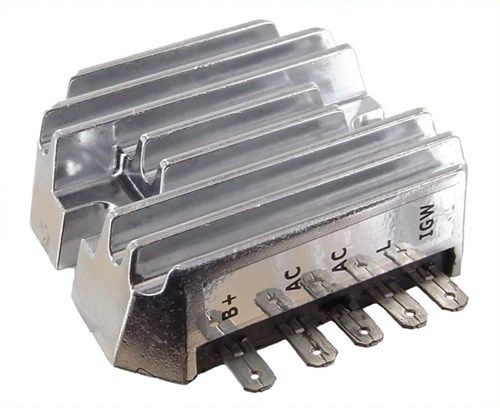
Searching on the VAF site, some of the RV-12 guys reported good success swapping the stock Rotax 912 regulator for a replacement unit. This unit is similar to the Kubota model, but has a higher output voltage (approx. 14.5 volts, vs. approx. 13.9 for the Kubota regulator). I recently swapped out my old Kubota regulator for the new model and have been flying it with good results. The output voltage has been stable, and the battery seems to charge well. In fact, even at low rpm I see higher voltage output that the old regulator, and the battery must like that.
The new unit looks very similar, and has the same bolt mounting pattern as the Kubota, but features fast-on male terminals rather than wires and a pigtail+OEM connector like the Kubota. The new one uses a case ground, but the rest of the connections are similar (the Kubota “ignition” (AKA voltage sense) wire is labeled “IGW” on the new one).
I use a “Caltric model R11-2, PN LD1293111RV”, but it’s listed as a replacement for the “John Deere Mower F915, AM101406”. There are others that look identical on Amazon and Ebay, and I have now idea if one brand is better than another. All I can say is mine is working well so far, and I’ll report again after 50 hours, or if problems resurface.
https://www.amazon.com/Caltric-Regulato … B008HTBHUI
https://www.ebay.com/itm/Regulator-Rect … 2749.l2649
s-l500b.jpg (33.06 KiB) Viewed 12412 times
edit August 2019: follow-up posted at:
viewtopic.php?f=8&t=5076
Jeff
Re: Voltage Regulator Failures
Posted: Mon Nov 06, 2017 6:58 pm
by daleandee
Daviator wrote:Executive summary - Don’t buy cheap Chinese made regulators, stick with the Kubota brand, made in Japan, original equipment. If you want more detail keep reading.
Things to remember:
- Seeing 14.7 volts while the engine is running is acceptable for the Odyssey PC625 battery.
Good post! While my Cleanex uses a Corvair engine the power is supplied by a permanent magnet alternator i.e. a “dynamo.” The called for regulator is the one used with it on the John Deere equipment that it was designed for. They are made in Japan, are a bit expensive, and work like they’re supposed to. I went through the cheap regulator phase and realized that saving money by purchasing junk regulators for an aircraft that is electrically dependent was not a route that I wanted to continue on. Seems to me I paid about ninety bucks for the regulator I got but it has been flawless since. The cheap one I bought regulated voltage too low, had stuff that would seep out of it (the manufacturer said that was normal), and the over voltage light would flicker at idle and get brighter with more throttle.
I use the Odyssey PC-680 and read that charging is at 14.7 - 14.8 VDC and should not exceed 15.0. Charging an Odyssey battery with too little voltage will eventually damage it. I used my first PC-680 for two years and, although it was still working as good as new, I replaced it as I didn’t want to get caught somewhere with a low battery. It sat on the shelf in my shop for another two years with out any thing attached to it. I pulled out the four year old battery, put it in the lawn tractor, and it cranked right up!
I haven’t found the need to use a trickle charger on an Odyssey battery that gets flown and properly charged now and again. Some builders desire to save money with cheaper batteries and regulators and that’s fine. There’s nothing wrong with inexpensive items … provided they work up to the standard that is required. The builder is the one that sets the standard for what is acceptable to them.
Dale Williams
N319WF @ 6J2
Myunn - “daughter of Cleanex”
120 HP - 3.0 Corvair
Tail Wheel - Center Stick
Signature Finish 2200 Paint Job
161.6 hours / Status - Flying
Member # 109 - Florida Sonex Association
Re: Voltage Regulator Failures
Posted: Mon Nov 06, 2017 7:34 pm
by rizzz
Daviator wrote:Executive summary - Don’t buy cheap Chinese made regulators, stick with the Kubota brand, made in Japan, original equipment. If you want more detail keep reading.
Not only Chinese regulators are known to be of lower quality.
I had a Harley Davidson brand 20amp Alternator & Voltage regulator on my custom VW conversion.
The regulator broke after less than a year of service.
Talking to some experienced bike builders I was advised to stay away from the original Harley Davidson brand electrical stuff and go with aftermarket Japanese copies, they seem to survive much longer. So that’s what I did, my new regulator is holding up so far, I still have the original HD alternator installed but have my Japanese copy ready as well for when it breaks.
Re: Voltage Regulator Failures
Posted: Tue Nov 07, 2017 11:53 am
by sonex1374
We’re all getting at the same basic problem with sourcing after-market regulators, and that’s the difficulty in finding a good quality one. The only way we can address this is to be a specific as possible. I’ll ask everyone contributing to this thread to be specific, including manufacturer name and part number. Many of these regulators that appear on Amazon or EBay all look the same, so without specific details to work with it’s hard to make an informed choice. Price is certainly not an indicator (or a guarantee) of quality.
So, for those that have specific details of good (or bad) regulators, please contribute your info to the knowledge bank.
Jeff
Re: Voltage Regulator Failures
Posted: Tue Nov 07, 2017 2:53 pm
by Paul Johnson
I bought my Jabiru 3300 in 2014 and installed it in a Bristell aircraft, I also installed a crowbar to protect my instruments against voltage surges, I don’t know how beneficial this is with a permanent magnet alternator. After about 15 hours of flying the crowbar tripped, the first indication of this was the loss of RPM indications on the Dynon EMS120, the cowls were removed and a thorough inspection carried out, a little arcing was found on one of the faston terminals on the relay which is part of the crowbar circuit, the relay and faston terminal were replaced but a few hours later the crowbar tripped again. No indications of over voltage had been observed so we thought the crowbar maybe oversensitive, the crowbar was removed and all seemed fine for the next few hours of flying until a light smell of burning was noticed on a local flight, the master switch was put in the off position and a return to the airfield was made with the burning smell still remaining.
After landing the cowls were again removed and it was then we saw the inside of the voltage regulator had melted and a tar like substance was running down the firewall. The voltage regulator was only 25 hours old and was the one supplied with the Jabiru engine and had no makers emblem on it " it was not a Kubota" a Kubota was ordered and fitted with no more problems.
Re: Voltage Regulator Failures
Posted: Tue Nov 07, 2017 6:50 pm
by Corby202
A lot of flyers in Australia use these, http://www.powermate.com.au/
Re: Voltage Regulator Failures
Posted: Tue Nov 07, 2017 11:03 pm
by tonyr
I have replaced 2 regulators in 220hrs
The original item that came with the brand new engine (circa 2012 - 2200) failed after about 39 hours.
The unit is mounted high on the fiirewall alongside the filler neck, but has no external cooling air supplied to it.
I purchased an aftermarket item from eBay - Kubota 15531-64603 RP201-53710 UTV RTV500
https://www.ebay.com.au/itm/New-VOLTAGE-REGULATOR-RECTIFIER-Grasshopper-Kubota-185530-RP201-53710-/271095558363?hash=item3f1e8df0db
Suspecting the previous unit failed due to overheating, I mounted a computer fan on a bracket over the replacement regulator. The fan is powered whenever the master swtch is on.
That was 180 hours ago.
As alluded by others, I believe excessive heat leads to early failure if there is no supplemental cooling.
As a footnote, I also use a terminal block for the alternator leads, instead of going through the connector to prevent issues with the spade connectors overheating.
Re: Voltage Regulator Failures
Posted: Wed Nov 08, 2017 11:02 am
by lgsievila
As a footnote, I also use a terminal block for the alternator leads, instead of going through the connector to prevent issues with the spade connectors overheating.
I also cut the connector off and went through a terminal block. It would be interesting to know how many failures occurred on regulators where people used a spade connector instead of a terminal block. As a side note I have a Kubota tractor with over 1400 hours on it that has the exact same regulator that is on my plane.
Re: Voltage Regulator Failures
Posted: Wed Nov 08, 2017 6:32 pm
by DCASonex
Suspect you are right about heat being major problem. Have had same regulator on my Sonex since 2012, even though changed engine to a CAMit. It is also high on firewall, behind the left cylinder bank, but have a cooling air jet from intake plenum blowing on it. Do need to orient with fins vertical for good airflow and for convection cooling after shutdown. The original spade lug connectors on Jabiru and CAMit flywheel alternators are grossly undersized for the current. Replacing them with good quality lugs rated 30 amp or better seems to eliminate that problem.
David A.
Re: Voltage Regulator Failures
Posted: Wed Nov 08, 2017 6:38 pm
by DCASonex
The Powermate regulator looks good, but the specs show it for 8 amps, while our flywheel alternators are rated from 17 to 20 amps (and I have briefly seen higher when first going to WOT as it recharges my EarthEx battery) ???
David A.
Re: Voltage Regulator Failures
Posted: Wed Nov 08, 2017 8:16 pm
by mike.smith
tonyr wrote:I have replaced 2 regulators in 220hrs
The unit is mounted high on the fiirewall alongside the filler neck, but has no external cooling air supplied to it.
OK, I have an AeroVee and not a Jabiru, so maybe not the same, but that’s the location where I have mine (Sonex-supplied) and after 270 hours, no failures at all, with no supplemental cooling being supplied. All I did was mount it on short stand-offs so it is not touching the firewall.
Re: Voltage Regulator Failures
Posted: Sun Nov 11, 2018 8:39 pm
by N111YX
After 778 hours and 8.4 years of operation, My stock voltage regulator finally quit, I noticed a small charging value happening (12.4V) before takeoff but it went to battery voltage soon after takeoff. Incidentally, I lost my tachometer on the same flight. It shows zero on my Dynon D-180. I’ll add that I have no cooling on the regulator.
I guess the old lady is showing her age.
Re: Voltage Regulator Failures
Posted: Sun Nov 11, 2018 11:36 pm
by builderflyer
Are you sure it isn’t the alternator itself that failed? If your tachometer takes its feed from one of the two alternator wires as does mine, it may explain why you lost the tachometer as well. Just wondering.
Art,Sonex taildragger #95,Jabiru 3300 #261.
