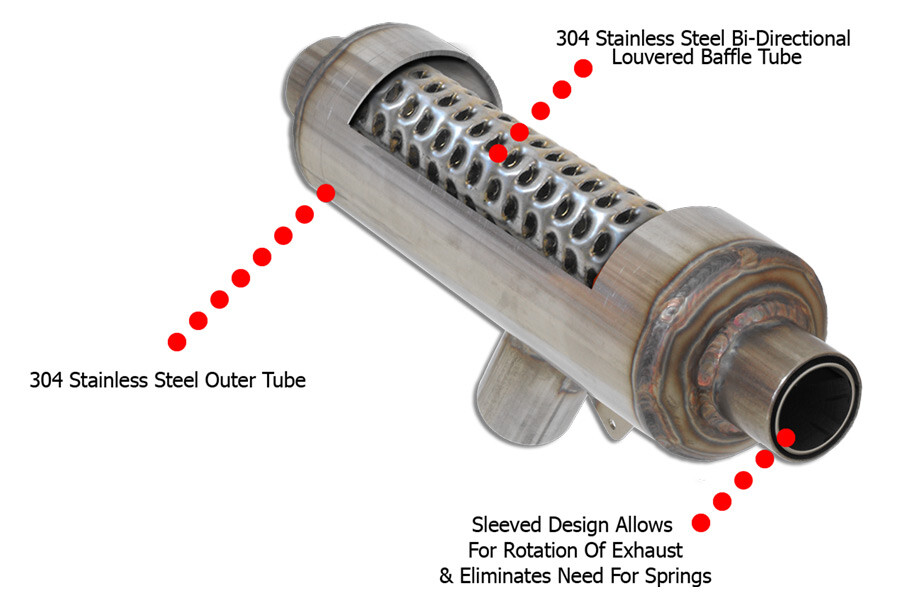
Is anyone running the Toucan exhaust on their 912? Specifically the latest version with the clamps rather than rivets holding the pipes? I had to modify my older riveted version quite a bit to get it to work properly, but it’s got 150 hrs of trouble free time on it now. The new clamping version seems better in many ways, but I do still have some doubts about whether it will crack since I don’t see any provision for allowing expansion when hot.
If anyone is running one, how many hours do you have on it?
I’m planning to buy the Toucan exhaust system when it makes sense to have one ready to mount. I’m also interested in hearing about others’ experience with them.
I actually have a Toucan exhaust on my Onex, but it was the original design that I think Greg purchased from the original maker. The original used a big rivet in each end of the pipe, which was a bad idea in many ways. Mine was failing at only 30 hrs or so at those rivets, and I made a lot of modifications to the pipes and mounting. I’ve got 150 hrs since the final fix with no issues.
I need an exhaust for the Top Rudder Ruckus I’m finishing up, and I contacted Greg to see if they made any changes after he got more involved with the design. As it turns out, they do have a clamping system now that eliminates drilling holes and putting in rivets. This is going to be a big improvement over the one I originally got maybe 5 years ago.
I did just order the V2 version today, but I’m still concerned that there doesn’t seem to be any provision for expansion. After I got rid of my rivets on the old system, I went through a few versions of clamps, but that cracked the rear pipe in about 6-8 hrs every time. I ultimately added a couple SS ball joints in the rear pipes which finally gave it enough flex to not break.
The idea is fantastic for clearance, and I’ve had no reason to think it’s hurting performance. I don’t have a stock version to compare to, but people tell me it’s one of the quieter airplanes at our airport. I know the fix if there is an issue, but hopefully it will work. I doubt anyone actually has many hours on this version, so I guess I’ll take one for the team and find out
I have no experience with the Toucan exhaust. Your post peaked my interest, so checked out the web site.
No mention of any securing system (rivets or clamps) however they do state “Sleeved Design Allows For Rotation Of Exhaust & Eliminates the Need For Springs”. This suggests to me that securing systems are not required. Further a securing system may not allow for thermal movement resulting in cracking (your problem)
Are you detrimentally modifying the system by adding some form of securing devise (rivets/clamps) ?
I have no experience with the Toucan exhaust. Your post peaked my interest, so checked out the web site.
No mention of any securing system (rivets or clamps) however they do state “Sleeved Design Allows For Rotation Of Exhaust & Eliminates the Need For Springs”. This suggests to me that securing systems are not required.
I followed the instructions to the letter. I’ll attach them since I don’t see them on the website anywhere. Again, the website is woefully out of date regarding the newer clamping method.
Seems to me that riveting both joints (exhaust to mufler) would be the most likly to result in problems (which you have mentioned) and clamping not much better. You may be able to get away with clamping just one joint. ie the free joint must then allow sufficient movement to accomodate all expansion/contraction movement
Thermal Expansion/Contraction must be accommodated some way . Automotive exhausts use a section of corrugated, flexible pipe, or slip joints.
Rotax OM exhaust systems use a ball /socket joint held together with springs.
I have seen aircraft corrugated systems.
The Toucan looks (?) like it should be a slip joint. If it is a slip joint, anything that prevents the slip (rivet/ clamp/etc) will result in cracking somewhere in the exhaust system.
I guess that the idea of the rivet/clamping, is to hold the tail pipe in the correct orientation & prevent it moving in the slip stream. This could also be achieved using a spring system, attached to a convenient point on the engine bed.
Instruction No 6 involves sealing/caulking the joint, to make it gas tight. If you could include a retaining ring, to ensure the caulking remained in place, you may be able to avoid clamping (allow for slip) The ring would need to be secured somehow - screw/crimp/rivet???
I have the Toucan exhaust on my Rotax 912 iS. I’ve only flown it a few times (life stuff has gotten in the way). The installation (without rivets) seems very secure. I don’t think it will move at all. The installation instructions were very detailed. Came with all the hardware & joint sealing compound. Would highly recommend.