Temperature Balancing by Turning/Twisting the Carb

Temperature Balancing by Turning/Twisting the Carb

Posted: Sun Jun 11, 2017 2:09 pm

by MichaelFarley56

Greetings Everyone,

I know this subject has been discussed many times in the past, and it seems to be one of those eternally debated topics of conversation, but what the heck, I’m curious…

I’m curious to hear feedback and information from those who are flying behind an AeroCarb/AeroInjector and successfully was able to balance engine temps (EGT and/or CHT) by somehow offsetting the carb. We all know and understand the goal here; if we can somehow favor the mixture towards one intake side or the other, this may possibly help temps by promoting one side of the engine to run a little richer or leaner. The common method is to either twist or tilt the carb to favor fuel delivery towards one side of the intake system slightly. Easy in theory, but I’m curious who all has actually tried this.

If you’ve ever fiddled with carb orientation for this purpose, could you please reply and let us know what the issue was, what you specifically did to the carb, and how it worked out.

I do admit that I want to (probably) fiddle with mine a little bit; on mine, both the EGTs and CHTs tend to run coolest on the front-pilot side cylinder (#4 I believe) to the hottest being the rear, copilot side (#3). In general though, on my AeroVee the pilot side cylinders tend to run richer than the copilot side, so if there’s a solution such as a carb twist to help balance things out, I’d be happy and willing to try. But I hate to run into this blindly, hence the thread.

If anyone has any experience here, please share!

Thanks Everyone!

Mike


Re: Temperature Balancing by Turning/Twisting the Carb

Posted: Sun Jun 11, 2017 2:25 pm

by gammaxy

On my Aerovee, I rotated it about 15 degrees and didn’t notice any change, so I rotated it back to the initial orientation. My left cylinders also seem to run cooler than the right ones.


Re: Temperature Balancing by Turning/Twisting the Carb

Posted: Sun Jun 11, 2017 7:17 pm

by MichaelFarley56

That’s interesting Chris. I know these engines aren’t fuel injected so they won’t be perfectly balanced, but I do run into CHT issues on high performance climbs. My right rear cylinder gets warm but it’s also the leanest so it would be nice to get that cylinder some more fuel at full throttle.


Re: Temperature Balancing by Turning/Twisting the Carb

Posted: Sun Jun 11, 2017 8:34 pm

by fastj22

I think its more of an issue on the Jabiru. The intake is very close to the back two cylinders. So there isn’t much run to atomize. A small change in the orientation on mine can make big changes on how lean #6 and #5 in comparison. The forward four don’t seem to care. #6 is always my leanest on climb out. Its closest to the intake. Turbo guys shouldn’t matter a nit. And even aerovee with your long intake run.


Re: Temperature Balancing by Turning/Twisting the Carb

Posted: Sun Jun 11, 2017 10:52 pm

by sonex892.

fastj22 wrote:I think its more of an issue on the Jabiru. The intake is very close to the back two cylinders. So there isn’t much run to atomize. A small change in the orientation on mine can make big changes on how lean #6 and #5 in comparison. The forward four don’t seem to care. #6 is always my leanest on climb out. Its closest to the intake. Turbo guys shouldn’t matter a nit. And even aerovee with your long intake run.

I realise this thread is about aerocarb. My experience is only with a bing on my 3300. When it comes to balancing the mixture by rotating the carb, I find that less rotation is actually more. When tuned so both left and right banks are reading pretty even. A matter of just a degree or 2, maybe even less, will spread the left vs right cruise EGTs by 50 degree C.


Re: Temperature Balancing by Turning/Twisting the Carb

Posted: Sun Jun 11, 2017 11:52 pm

by jeff0196

My experience with the naturally aspirated AeroVee and cht and egt is the same as yours. The front run richer then the rears, and the left cooler then the right. My friend and I tried twisting the carb. First 15 degrees, no change, then 30, no change, then 90, no change, then 90 the other side to see if we could make it worse. No change. We gave up with moving it. I have a theory that fuel is dropped into the airstream in large slugs/droplets with the aeroinjector. When they make it to the intake manifold on the head, the inertia carries the heavier still liquid fuel drops to the front cylinders due to the design of the intakes. The left/ right balance must be more like pulses in the manifold and moving the injector one way or the other doesn’t seem to help. I think the both left then both right cylinder firing order contributes to this. The uneven running of this system was one of the biggest draws toward the turbo that in my opinion being a draw through turbo can make a homogeneous mixture under pressure that is much less sensitive to the effects of inertia and runs more evenly.


Re: Temperature Balancing by Turning/Twisting the Carb

Posted: Mon Jun 12, 2017 12:04 pm

by sonex1374

I have a theory that fuel is dropped into the airstream in large slugs/droplets with the aeroinjector. When they make it to the intake manifold on the head, the inertia carries the heavier still liquid fuel drops to the front cylinders due to the design of the intakes.

This is exactly the conclusion I have come to as well. The intake design of the AeroVee is simple and compact, and has a lot going for it. However, getting perfect mixture distribution into the front/back cylinders is a bit harder because of this design. I have experimented with various means to better mix the fuel/air charge in the intake, but all the methods I tried were unpredictable and ultimately not worth keeping. I’ve often thought of continuing the experimentation with vanes installed in the intake runners to better split the intake flow to the front and rear cylinders, but haven’t done this yet. The turbo, however, is clearly the best mixture-homogenizer out there!

I have also experimented with twisting the carb, and I have also found that a few degrees one way or another will have an impact. However, if you are running overly-rich to begin with, you probably won’t notice the change (it will be obscured in the data). Try leaning to a very efficient mixture setting in flight and you should see the effect.

Jeff


Re: Temperature Balancing by Turning/Twisting the Carb

Posted: Mon Jun 12, 2017 10:00 pm

by rizzz

jeff0196 wrote:I have a theory that fuel is dropped into the airstream in large slugs/droplets with the aeroinjector. When they make it to the intake manifold on the head, the inertia carries the heavier still liquid fuel drops to the front cylinders due to the design of the intakes.

It’s a shame I only measure EGT’s on my rear cylinders (my MGL E1 only has 2 EGT inputs), as I believe the revmaster style intake manifold I have on my VW would fix this issue if your theory is correct. We would have some data to confirm it:
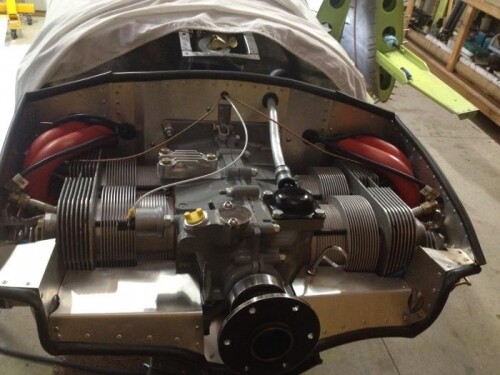
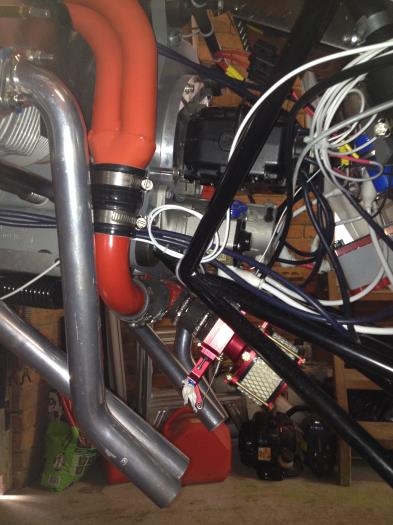
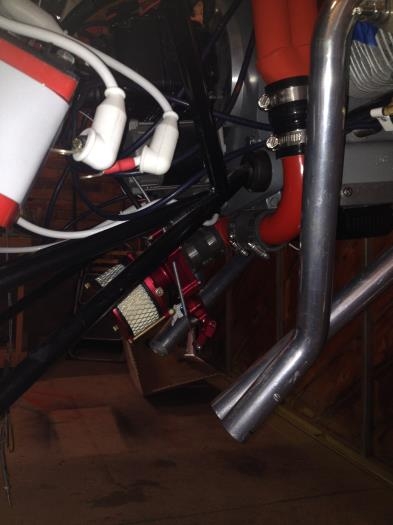

Re: Temperature Balancing by Turning/Twisting the Carb

Posted: Mon Jun 12, 2017 10:12 pm

by rizzz

And on that topic,

Here’s a recent learning I have to share, it may help others.
I recently did quite a bit of work on my engine including replacing the air filter on my AeroInjector.

When I went flying I noticed a serious imbalance in EGT’s left vs. right, well over 100 degrees C! The engine was also not running very well and I had to get the mixture setting just right to get it to run at all.
Obviously that flight wasn’t a very long one.

Comparing the data too older EGT data recorded during phase 1, it seemed EGT’s just went way lower than before on the left and way higher than usual on the right.
I had a serious mixture imbalance all of the sudden.

Because of all the work I had done on the engine it did not immediately come to me what the cause of this sudden problem was but to cut a long story short, it turned out to be the new air filter.
Once I replaced that again with another one all problems went away. Nothing looked obviously wrong with the bad one but I must admit I did not inspect it in detail, it must have had a tear or something which would perhaps “swirl” the air intake much more than usual and thus getting it pushed more towards one side than the other.

Anyway, this might be something to look at if you’re struggling with left/right EGT imbalance.


Re: Temperature Balancing by Turning/Twisting the Carb

Posted: Tue Jun 13, 2017 2:01 pm

by Doron

It looks like the Jabiru main problem is the carburetor is very close the the manifold.
Is anyone ever try to extend the distance by adding a tube between the carburetor and the the manifold ?

Doron

Re: Temperature Balancing by Turning/Twisting the Carb

Posted: Tue Jun 13, 2017 9:26 pm

by vwglenn

Mike,

All VWs are notorious for the temp issue you describe. #3 is consistently the hottest cylinder in the cars for a multitude of reasons. It might be extremely difficult to beat that out of it.


Re: Temperature Balancing by Turning/Twisting the Carb

Posted: Mon Jul 10, 2017 3:37 pm

by lutorm

Our AeroVee also has a very uneven mixture between front and back cylinders. I tested a redesigned (3d-printed!) intake elbow to see if it would alleviate the problem:
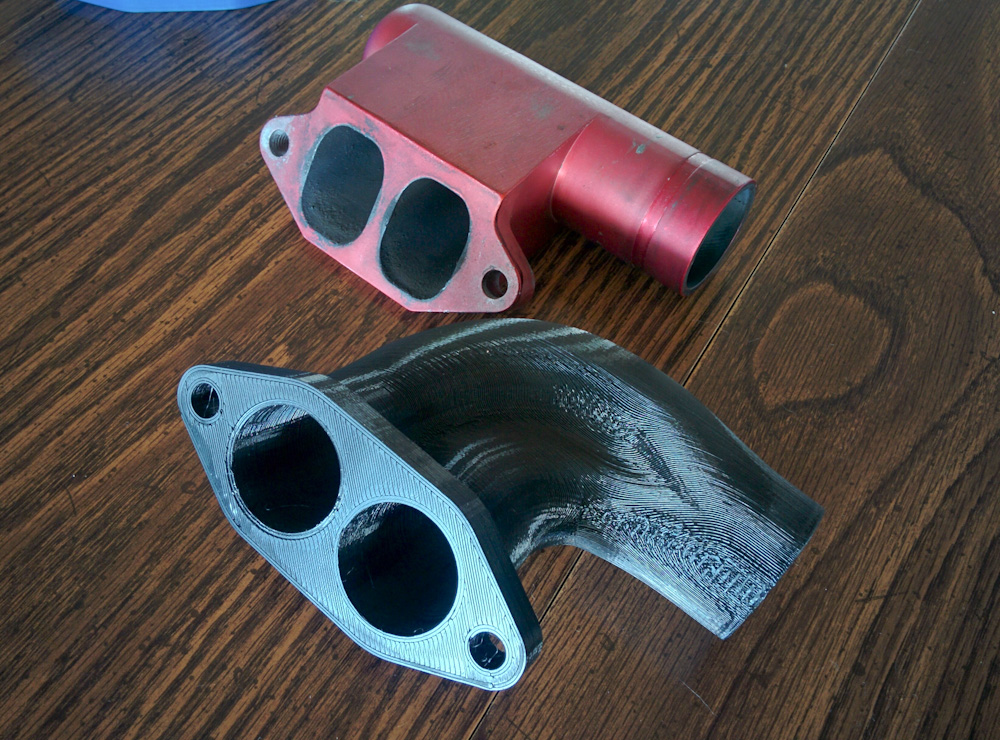
The short story is that avoiding the 90-degree turn helped even the mixture out some, but did not fix the problem entirely. I’ve written the experiment up here. It has EGT plots comparing the stock and custom intake.

Ultimately I think the solution is to run a separate intake runner for each cylinder, none of this tying together of cylinders (especially the ones on the same side that are firing unevenly.)


Re: Temperature Balancing by Turning/Twisting the Carb

Posted: Mon Jul 10, 2017 5:39 pm

by Fastcapy

I have similar intake elbows and it bumped up my rpms a bit (150ish static) and evened out the temps fairly well. With the rounded elbows and the Rotec TBI I have pretty consistent temps across the cylinders now and haven’t had problems with high CHTs like I did before the changes.


Re: Temperature Balancing by Turning/Twisting the Carb

Posted: Mon Jul 10, 2017 7:24 pm

by MichaelFarley56

That’s a cool experiment! I can’t help but agree with you guys; I tried to accomplish the same thing by pulling the red 90 degree intake elbows and installing a set of Great Plains (had to modify them a little to fit) intake elbows. In fact, they look a lot like the 3D printed ones above.

They helped slightly, but just slightly overall. On my engine, the front two cylinders nearest the prop are certainly richer while the back two are leaner overall.

I also think there may be some limitations with the airflow through the cowling as well, at least on my engine. My back two cylinders nearest the flywheel have nearly identical EGT readings, but the pilot side cylinder (Sonex calls it #1; I call it #3) runs around 30 degrees cooler than the rear copilot side (Sonex calls it #3; I call it #4). If there’s a balance of mixture but a cylinder head difference, that almost has to be baffling/cooling air flow. I do have the top mounted oil cooler so maybe that’s blocking some air? I have played with some air dams in front of the cylinders a little to get more air to the back cylinders but haven’t had much luck there either. Oh well, it’s something to mess with!

Ultimately I also agree that a redesigned intake system with 4 equal length intake pipes, one to each cylinder, would help balance things. If someone wants to make me one, I’d be happy to try it out!! :smile:


Re: Temperature Balancing by Turning/Twisting the Carb

Posted: Mon Jul 10, 2017 10:17 pm

by kevinh

Wow lutorm,

That is a great experiment (also a cool 3d print). I’m really curious about your future experiments!

Kevin


Re: Temperature Balancing by Turning/Twisting the Carb

Posted: Mon Jul 10, 2017 10:18 pm

by Bryan Cotton

Nicely done! Fun stuff!


Re: Temperature Balancing by Turning/Twisting the Carb

Posted: Mon Jul 10, 2017 10:19 pm

by lutorm

Yeah, it was fun!

Yeah, there’s clearly also something to do with cooling, apart from the mixture isuue. My assumption was that the difference in temperature between the left and right was due to the propeller rotation which would make the airflow go down towards the cylinders on the left side and up towards the top of the cowling on the right side. I don’t know how much difference that would make in flight, though, all my tests have been ground runs.

(It would be an interesting experiment to take pressure measurements inside the cowling, just above the left and right rear cylinders, and see if they differ. I’m also in the process of getting set up to measure cooling airflow in the spirit of http://www.n91cz.net/Pressure/PlenumPressure.pdf, but I was only planning on measuring the average upper plenum pressure.)


Re: Temperature Balancing by Turning/Twisting the Carb

Posted: Mon Jul 10, 2017 10:25 pm

by kevinh

FWIW - Even with a lycoming in my previous plane I spent plenty of quality time filing flashing off of heads and tweaking baffles to get the EGTs closer between the front and rear cylinders.


Re: Temperature Balancing by Turning/Twisting the Carb

Posted: Tue Jul 11, 2017 6:56 am

by peter anson

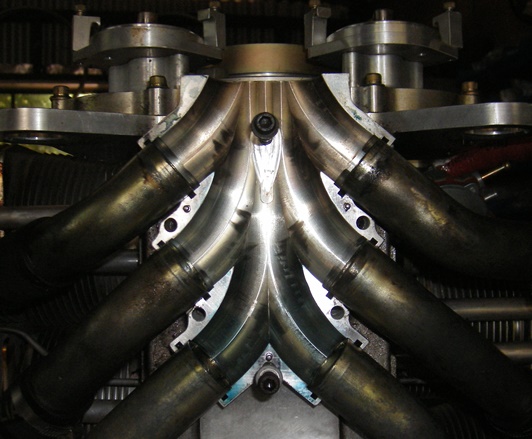
I think there is only so much you can do to even up temperatures. The photo below shows the internal passages of the Jabiru intake manifold. It’s really quite beautiful. They obviously went to lots of trouble trying to get even flow distribution, but my EGTs vary considerably, with a very noticeable difference between #5 and #6, the two outermost branches of the tree (top in the photo).
Peter

Re: Temperature Balancing by Turning/Twisting the Carb

Posted: Tue Jul 11, 2017 8:17 am

by DCASonex

For what its worth, my old Jabiru 3300 which had intake manifold with the single airfoil flow divider, tilting the carb very slightly did have the desired effect, also with that manifold, replacing the airfoil shaped flow divider with a plain 1/2" (12 mm) dia. round rod cut the EGT spread at WOT about in half but at a cost of slight increase in spread at cruise.

My new CAMit engine appears to have an intake manifold identical to later Jabiru ones, with two round rod flow dividers. That does seem to result in reduced EGT spread, but tilting the carb has little effect with this manifold.

Briefly tried the new manifold on old engine after some work on it, and seemed to behave same on both.

David A.

Re: Temperature Balancing by Turning/Twisting the Carb

Posted: Tue Jul 11, 2017 11:10 am

by Onex107

Great work on the intake elbows. I thought the change would be greater. My left rear EGT is the hottest/leanest on climb out, but something I have noticed is that when that cylinder is getting hot, if I retard the throttle a small amount that cylinder will cool without a noticeable change in rpm. I thinking the throttle slide is not linear. At the wot position it goes lean and a small amount of change in slide position eliminates it. Just an unsupported observation.
From what I’m told by Bill Larson, the turbo is the best homogenizer for even temps. And, we all know that a warm/hot intake manifold runs better than a cold one. Lycoming design? Have you seen ice form on the manifold above the Aeroinjector? I’m thinking that more heat applied to the intake manifold wound increase atomization, reducing the heavy particles at the intake elbow. Ducting the top oil cooler over the pipes may be a simpler approach. Just saying.


Re: Temperature Balancing by Turning/Twisting the Carb

Posted: Mon Sep 04, 2017 10:07 pm

by lutorm

If you go back a page you’ll find the redesigned intake elbow I made to see if it would even out the mixture distribution on the AeroVee, with lackluster results. The conjecture was that a plenum with individual runners would take care of this. Well, here it is:
Image
The plenum is 3d-printed in a high-temperature, fuel-resistant nylon alloy, with four equal-length runners going to the cylinders. (These runners are also plastic, they will be replaced with stainless but the plastic is fine for testing.)

On the engine:

I finally did a test run today and even though it’s not tuned yet, the EGT spread has come down to less than half of what it was before and as a bonus it also picked up 60 static rpm to 3220. It won’t idle now, which is likely a vacuum leak somewhere, but I’m hopeful we’re on the right track.


Re: Temperature Balancing by Turning/Twisting the Carb

Posted: Mon Sep 04, 2017 11:25 pm

by kevinh

super cool - I love reading about this project.


Re: Temperature Balancing by Turning/Twisting the Carb

Posted: Tue Sep 05, 2017 2:05 am

by lutorm

kevinh wrote:super cool - I love reading about this project.

Glad you like it. If you’re interested, you can find all the gory detail on my blog.


Re: Temperature Balancing by Turning/Twisting the Carb

Posted: Tue Sep 05, 2017 8:03 am

by Bryan Cotton

Excellent gory detail. I’m rooting for you too, it is a cool project with some real potential benefits.


Re: Temperature Balancing by Turning/Twisting the Carb

Posted: Mon Sep 18, 2017 12:08 am

by lutorm

Turns out the 3D-printed plenum was very leaky. After coating it with epoxy the vacuum leak is gone and the engine runs and idles really well! Still have to re-tune the AeroCarb and I’m working on replacing the plastic intake runners with stainless, but this seems very promising.

https://blog.familjenjonsson.org/blog/2017/09/16/plenum-test-run-2/


Re: Temperature Balancing by Turning/Twisting the Carb

Posted: Mon Sep 18, 2017 9:12 am

by Darick

Must be at least 15 years ago I read about a theory that the fuel/air mixture coming out of the carb, in this case automotive, was not atomized sufficiently for ideal combustion. It’s still a mist and not a vapor…vapor being the state that actually ignites which is why gasoline appears to be burning off the top of a gasoline puddle.

This fellow put some kind of very small ultrasonic black box in the intake manifold which resulted in better mpg, presumably because the transition between mist and vapor after passing over the ultrasonic gizmo was completed and now, only vapor was introduced into the combustion chamber.

I have no further knowledge of this experiment. Anybody else care to postulate a theory?


Re: Temperature Balancing by Turning/Twisting the Carb

Posted: Tue Sep 19, 2017 2:25 am

by lutorm

Darick wrote:Must be at least 15 years ago I read about a theory that the fuel/air mixture coming out of the carb, in this case automotive, was not atomized sufficiently for ideal combustion. It’s still a mist and not a vapor…vapor being the state that actually ignites which is why gasoline appears to be burning off the top of a gasoline puddle.

This fellow put some kind of very small ultrasonic black box in the intake manifold which resulted in better mpg, presumably because the transition between mist and vapor after passing over the ultrasonic gizmo was completed and now, only vapor was introduced into the combustion chamber.

I have no further knowledge of this experiment. Anybody else care to postulate a theory?

It’s certainly true the gasoline has to vaporize to burn. Maybe you can break up large drops with ultrasound, but in the end you have to supply the latent heat of vaporization. It would be interesting to know whether the ultrasonic gizmo also produced a noticeable lower temperature in the manifold.

I did a quick back of the envelope calculation for my situation. Fuel flow at full throttle is about 30l/h or 0.5l/min or 0.36kg/min. At 3000rpm the engine will pump 2.18*3000/2 = 3300 l/min air (assuming 100% volumetric efficiency) or 4kg/min. (Incidentally this is an air/fuel ratio of 11 which is in the right ballpark.)

According to some old military table I found, avgas has a latent heat of vaporization of ~375kJ/kg. To vaporize 0.36kg/min of avgas we thus have to supply 135kJ/min of heat. Air has a specific heat of 1kJ/kgK so if all that heat were to come out of the air it would have to drop 135/(41) = 34 degrees C. Observed temperature drop is 11C, so by the time it’s in the plenum, about 1/3 of the gasoline should have evaporated. The rest will presumably evaporate as it hits the hot intake tract and the intake valve.

It’s interesting to note that the numbers come out to mean a significant fraction of the gasoline has evaporated already inside the plenum. And cooling the intake charge is always good – the cooler the air, the more mass you can fit into the cylinders. (This is one of the reasons why you can get higher power out of an engine by running E85, ethanol takes a lot of energy to evapolate, so it will cool the intake charge much more than gasoline.)


Re: Temperature Balancing by Turning/Twisting the Carb

Posted: Tue Sep 19, 2017 1:58 pm

by gammaxy

Your measurment is the first I’ve seen of temperatures after the Aerinjector. In my mind that measurement seems important to understanding the Aeroinjector’s resistance to icing.


Re: Temperature Balancing by Turning/Twisting the Carb

Posted: Wed Sep 20, 2017 2:20 am

by lutorm

gammaxy wrote:Your measurment is the first I’ve seen of temperatures after the Aerinjector. In my mind that measurement seems important to understanding the Aeroinjector’s resistance to icing.

Yeah, I think the key is that there’s no venturi that lowers the pressure and temperature right where the throttle is, since it takes a while for the gasoline to evaporate. Even if the evaporation would take the air temperature below freezing, it doesn’t have anything to freeze onto except the intake walls which are heated from the outside. This is unlike the throttle butterfly in a traditional carb which basically sits entirely inside the cooled airstream.

Re: Temperature Balancing by Turning/Twisting the Carb

Posted: Wed Dec 19, 2018 2:20 am

by lutorm

Just to close the loop on this discussion, we finally got our Aerovee with the custom intake plenum flying again. I haven’t flown it myself but my co-owner/builder says it’s running super well. There is still some unevenness in the CHTs, but it’s now possible to climb at full throttle without any of the CHTs hitting 400F, and the cylinders aren’t even broken in yet.

I don’t yet know to what extent the temperature difference now is mixture or cooling, we need to do some dedicated tests once we know it won’t come apart on us.

Best of all, the intake plenum doesn’t get warmer than 150F, and that’s only after shutdown, so there’s no danger of melting the 3-d printed plastic!


Re: Temperature Balancing by Turning/Twisting the Carb

Posted: Wed Dec 19, 2018 9:37 am

by bvolcko38

Do tell! I am having the same problem with my Aerovee with stock intake. Please tell me more. I have not seen your posts on this list before. I have a very hot #1 and hot #3 cylinder. If I richer the mixture enough to to have the temps acceptable on 1 then it starts to stumble rich on the front cylinders.


Re: Temperature Balancing by Turning/Twisting the Carb

Posted: Wed Dec 19, 2018 12:38 pm

by lutorm

Read back through this thread for a description if what I did.


Re: Temperature Balancing by Turning/Twisting the Carb

Posted: Wed Dec 19, 2018 3:01 pm

by Onex107

We need to hear more about your design and build. All the details. don’t assume we heard it before. Please.


Re: Temperature Balancing by Turning/Twisting the Carb

Posted: Wed Dec 19, 2018 3:21 pm

by Bryan Cotton

If you read back through this thread lutorm provides links to his blog on the topic. It is there! Just need to go back a page or two.


Re: Temperature Balancing by Turning/Twisting the Carb

Posted: Wed Dec 19, 2018 7:14 pm

by mike.smith

bvolcko38 wrote:Do tell! I am having the same problem with my Aerovee with stock intake. Please tell me more. I have not seen your posts on this list before. I have a very hot #1 and hot #3 cylinder. If I richer the mixture enough to to have the temps acceptable on 1 then it starts to stumble rich on the front cylinders.

There are lots of potential reasons. My own experiences and solutions start here on my Kitlog site:
http://www.mykitlog.com/users/display_l … 932&row=11
Item #6 is something I no longer think is/was an issue and I run my oil right at the full mark.
The other thing I didn’t note there (I’ll have to update it) is that I ran for too long with the #2 needle. Once I switched to the 2.5 needle and did a little trial and error tuning, that changed a LOT of what was going wrong. Not everyone will experience proper metering with the same needle number, but you should be willing to try others. I’ve had my current AeroInjector setup now for nearly 4 years and I’ve not made any adjustments to it even going between 100 deg summers and zero degree winters.


Re: Temperature Balancing by Turning/Twisting the Carb

Posted: Sat Dec 22, 2018 3:24 am

by lutorm

Onex107 wrote:We need to hear more about your design and build. All the details. don’t assume we heard it before. Please.

Yeah, it’s all in the links I give in this thread. I’m planning to write it up for the Sonex Foundation newsletter, but I want to get a solid chunk of flight data first.


Re: Temperature Balancing by Turning/Twisting the Carb

Posted: Fri Dec 28, 2018 12:15 am

by lutorm

One interesting thing about using a plenum as opposed to the stock intake pipe is that the larger intake volume also holds a large amount of fuel. In steady-state this has no effect on the operation of the engine, but it does when throttling up or down. When the throttle is opened, you immediately get more air but it takes a while for the plenum to get “filled up”, leading to an initial lean condition. (This is why carburetors and fuel-injection systems have an “accelerator pump” function, to momentarily add more fuel and avoid this initial lean spike.) Conversely, when the throttle is closed, there is too much fuel in the plenum for the new airflow and the engine momentarily runs rich. (The latter is very noticeable with the my plenum, when quickly closing the throttle from full power, you get a distinct rich misfire as the rpms come down.)

Anyway, I was just reading about the “Aerocarb burps” and realized that the fuel contained in the plenum probably also makes this effect much less severe. With the stock intake, an air bubble in the fuel line will lead to a lean spike, but with the plenum the effect gets “smoothed out” as the engine continues to run on the fuel that’s already present.


Re: Temperature Balancing by Turning/Twisting the Carb

Posted: Sat Dec 29, 2018 4:28 am

by N190YX

Interesting reading. I would add that with any aircraft engine, rapid movements of the throttle should be avoided, the throttle should be moved slowly enough that the engine RPM will continuously match the throttle position, both on the ground and in flight. I shudder when I hear pilots jockeying the throttle around in ground operations, their flight instructors should have taught them to be gentle with the throttle movement. This is critically important in larger engines with weights on the ends of the connecting rod caps, but, being blunt, it is poor technique to jerk the throttle around on any aircraft engine at any time. Please be kind to your engines and operate the throttle smoothly!


Re: Temperature Balancing by Turning/Twisting the Carb

Posted: Sat Dec 29, 2018 5:17 pm

by lutorm

N190YX wrote:… it is poor technique to jerk the throttle around on any aircraft engine at any time. Please be kind to your engines and operate the throttle smoothly!

I agree. (Although it is, by definition, not possible to move the throttle at all if you want it to always match the RPM…) What I mean by “quickly” in this case is closing the throttle from full power to idle over maybe 4s. Surely any car-mounted VW experiences throttle changes much quicker than that.

With the plenum you get worse transient response than with the stock intake. To not get a noticeable mixture excursion, I think you’d need to go from full to idle over maybe 15s. I doubt many people have the patience for that… :wink: Now, opening the throttle you have to be more careful, precisely because if you do it too fast you’ll get a lean stumble and the engine won’t respond.
Re: Temperature Balancing by Turning/Twisting the Carb

Posted: Thu Mar 28, 2024 11:13 am

by Bryan Cotton

rizzz wrote:And on that topic,

Here’s a recent learning I have to share, it may help others.
I recently did quite a bit of work on my engine including replacing the air filter on my AeroInjector.

When I went flying I noticed a serious imbalance in EGT’s left vs. right, well over 100 degrees C! The engine was also not running very well and I had to get the mixture setting just right to get it to run at all.
Obviously that flight wasn’t a very long one.

Comparing the data too older EGT data recorded during phase 1, it seemed EGT’s just went way lower than before on the left and way higher than usual on the right.
I had a serious mixture imbalance all of the sudden.

Because of all the work I had done on the engine it did not immediately come to me what the cause of this sudden problem was but to cut a long story short, it turned out to be the new air filter.
Once I replaced that again with another one all problems went away. Nothing looked obviously wrong with the bad one but I must admit I did not inspect it in detail, it must have had a tear or something which would perhaps “swirl” the air intake much more than usual and thus getting it pushed more towards one side than the other.

Anyway, this might be something to look at if you’re struggling with left/right EGT imbalance.

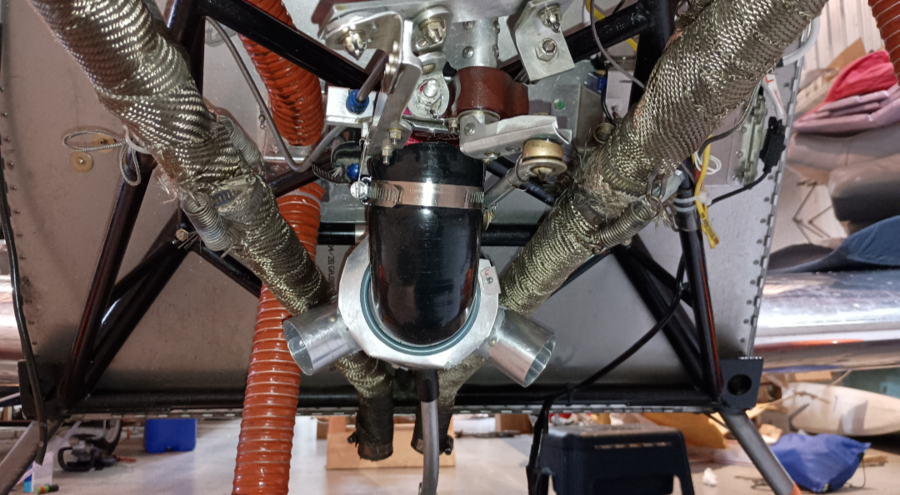
I may have done this inadvertently with my addition of fresh air induction. It goes into the air filter very asymmetrically.


Re: Temperature Balancing by Turning/Twisting the Carb

Posted: Sun Apr 28, 2024 11:46 am

by Bryan Cotton

Here’s the next phase of my experiment. Symmetrical-ish inlets to the shroud.

air filter shroud with dual inlets.png