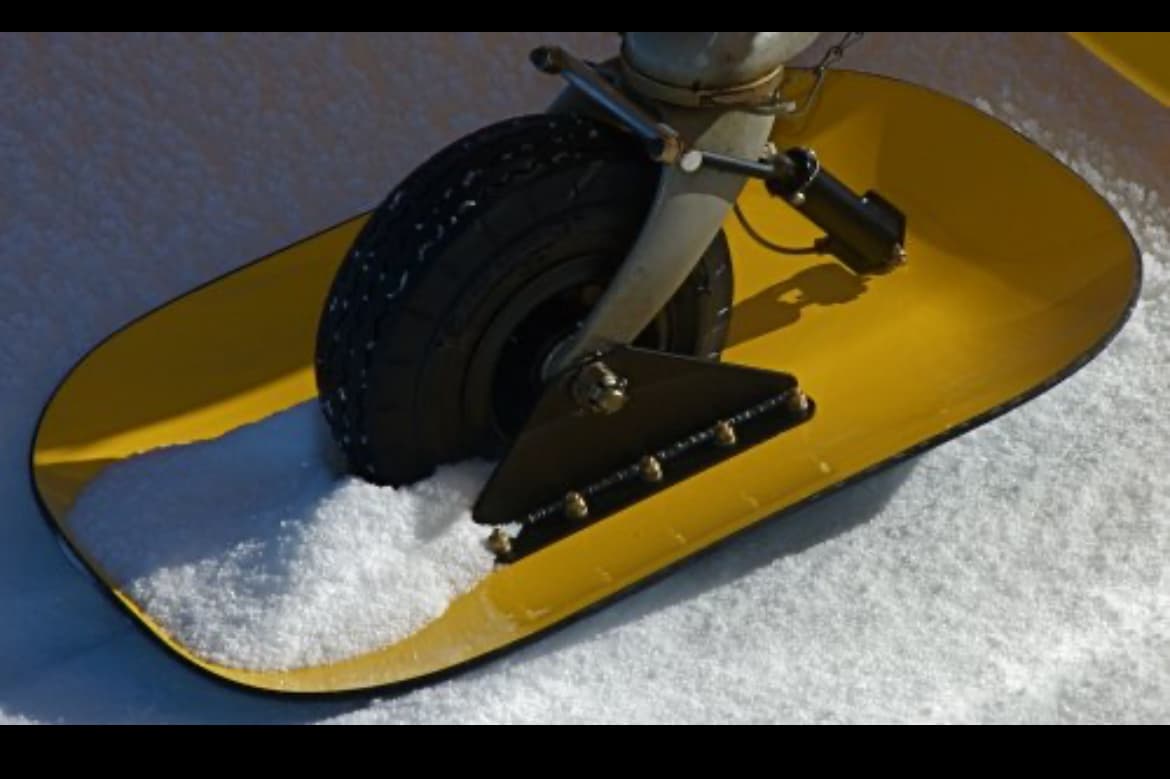
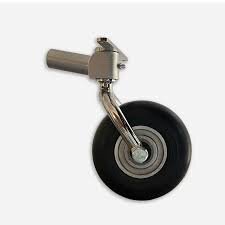
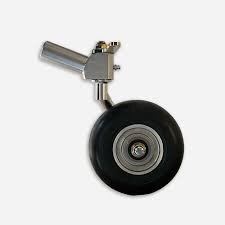
Sonex Legacy, tail wheel D 100mm (4”) x about W 30mm (1.25”) .
Had a lot of rain on my local grass airfield, more to come. Weather has been so bad, I haven’t flown in over a month.
I have managed to get my bird stuck once - that was enough, no more risking soft ground. Tail wheel digs in.
I have tried reducing the weight on the tail, using elevator & adding some power. Makes me nervous, as I know that full power will actually lift the tail off the ground and I doubt my skill to taxi on just the mains.
I have been toying with the idea of a temporary tail wheel skid. Not quite sure how it would be attached or what it would be made off. Would need to be at least W 60mm (2.5”) -75mm (3”) to reliably “float” (not penetrate) the soft surface.
Looks like Peter is now offering a castoring model which I might switch to.
With our poor AUD exchange rate, it might also be a cheaper option and probably for your situation the 150 x 50mm wide tyre would be a lot better at ploughing through the mud than the 4”
Very familiar with Peter Ansons excellent products. Have been in contact over this issue no less than twice. Recently & about 12-18 months ago, after the last sustained/flooding rains.
Problem is, I would loose my custom designed/made “yoke” (the bit between fork assembly & spring). The yoke determines the angle that the fork will be at relative to the spring.
Its not like this is a major problem - it only happens after sustained rains. I guess my options are;
Leave as is - put up with the inconvenience.
Keep trying for a replacement fork (6”) from AP or as suggested elsewhere JD Airparts (also not responding to emails).
Replace the whole system with a Peter Anson tail wheel
I have been in communication with API. They advise that the change from their 4" tyre & fork to their 6" tyre & fork, will raise the tail by aproximately 3" (76.2mm).
I wanted to see how this would impact on prop/ground clearance;
• My current prop to ground clearance is 3l5 mm (12.4”)
• I placed a 3” block under my existing 4” tail wheel, to simulate the 6” tail wheel & its fork assembly.
• The prop clearance decreased to 285 mm (11.2”) A drop of approximately 30mm (1.18”)
As I was on my own I could not easily assess the aircraft loaded change but would assume that the prop would be even lower /less clearance.
a conventional gear aircraft, Ground clearance is at a minimum when the tail is off the ground. Hence, tail wheel size is not a factor. As long as the prop clearance meets the requirements of your local aviation authority, it’s up to you to decide what is comfortable.
Response # 2 You should review all postings. For example :
And this from Flyboys Accessories: “ The upgraded tailwheel assembly will lift the tail of the airplane a few inches (the actual change will vary depending on which tailwheel setup you choose to use). For most pilots, this won’t be any issue, but if you like to do three-point landingsyou may consider what a few extra inches of tailwheel height does to your AOA on landing. You may consider upgrading to larger-diameter main wheels to balance things out. …”
Thanks John,
Of course you are correct - dumb of me not to realise that once the tail is off the ground its all on mains and they haven’t changed - so prop clearance as is.
What would be your guess on any performance penalty with the 6" ?
The Facebook answer… 5 knots…
A better answer. It’s highly unlikely any performance penalty is statistically significant. When comparing two populations, (data from the same aircraft, one set with 4” and one set with 6”) it’s important to consider the size of the sample. The larger the sample, the narrower the Confidence Level Interval (i.e. margin of error). The CLI is a nonlinear function. With a sample size less than 25 the CLI is wide enough to accommodate a 747. It requires a sample size of roughly 3,000 to get it down to a 3% margin of error. A 3% margin of error is a practical lower limit.
I doubt the delta V will be greater than the 3% margin of error.
There may be some differences in take off and landing as noted earlier.