Normal for an Aeroinjector?
Posted: Sun Jan 05, 2020 3:56 pm
by Area 51%
Not wanting to completely disassemble a new Aeroinjector unless I have to, how much movement should there be between the needle and slide, if any? No way for me to measure, but there is noticeable movement, both rotationally and longitudinally. I would have thought the needle should have no movement in relation to the slide.
Re: Normal for an Aeroinjector?
Posted: Sun Jan 05, 2020 4:11 pm
by pappas
I have used the aero carb on my Jab 3300 in 2007 and now the aero injector on my Aerovee turbo currently flying. It has been my experience that you are able to “wiggle” the needle a little bit by reaching into the carb throat. I think this is normal. The needle is not likely designed to be a “tight fit” in the fuel orifice.
I would assemble the unit according to the manual, install it, verify that the slide itself does not bind throughout its intended range of motion, and then follow the manual for tuning. Initial tuning is a source of frustration for many of us and for many others, it is not even a blip. We all go through it in the initial hours. Go figure. Hopefully, yours is the latter.
Lou Pappas
Waiex B 0010
Re: Normal for an Aeroinjector?
Posted: Sun Jan 05, 2020 9:41 pm
by mike.smith
The needle sometimes moves rotationally. To prevent that many of us have lightly peened the threads on the needle carrier. It’s also my experience that turning the set screw to tighten it can turn the needle. So whenever I set the set screw I did two things: 1. I reach into the carb orifice and use a thin Sharpie to mark a line where the needle meets the carb body. This way you can see if anything moves. 2. Hold onto the needle with your fingers while tightening the set screw, to prevent the needle from turning. After the set screw is tightened verify the needle has not moved by observing the Sharpie line on the needle. After tuning, I have not touched my needle in nearly 6 years.
Re: Normal for an Aeroinjector?
Posted: Mon Jan 06, 2020 12:54 am
by Onex107
Area 51% wrote:Not wanting to completely disassemble a new Aeroinjector unless I have to, how much movement should there be between the needle and slide, if any? No way for me to measure, but there is noticeable movement, both rotationally and longitudinally. I would have thought the needle should have no movement in relation to the slide.
The needle is mounted in the square needle holder block. Small movement side to side is normal. But longitudinal movement is not good and was caused by the ball joint of the adjusting screw having too much clearance in the needle block. Mine had nearly a half a turn worth of play. That’s a lot of movement when tuning. Tighten it up with shims or whatever why you can. I actually had a new screw and needle holder made with a sloted disk rather than a ball resulting in zero longitudinal play. Onex 107
Re: Normal for an Aeroinjector?
Posted: Mon Jan 06, 2020 7:29 am
by Area 51%
So what threads get peened? The little set screw that traps the needle, the adjuster threads, or the setscrew that locks the carrier in place?
Re: Normal for an Aeroinjector?
Posted: Mon Jan 06, 2020 10:29 am
by Rynoth
Area 51% wrote:So what threads get peened? The little set screw that traps the needle, the adjuster threads, or the setscrew that locks the carrier in place?
I peened/squished the threads on the adjuster needle screw, since that’s the screw I don’t want to move once it’s in place. The set screw then locks up that peened adjuster screw.
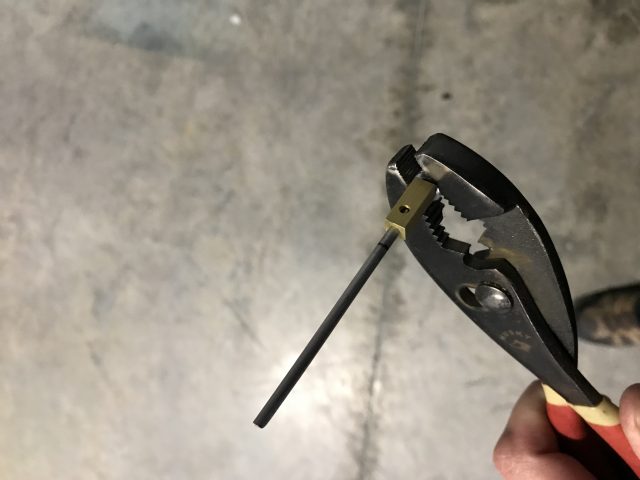
I followed the same process Mike used to make sure/verify the needle didn’t move as I was tightening the set screw.
http://www.rynoth.com/wordpress/waiex/2 … le-issues/
Re: Normal for an Aeroinjector?
Posted: Mon Jan 06, 2020 10:41 am
by bvolcko38
I had better results putting a 3/16" ball bearing between the needle carrier and the set screw. The ball does not impart any turning force to the needle carrier when you tighten the set screw.
Re: Normal for an Aeroinjector?
Posted: Mon Jan 06, 2020 2:57 pm
by Area 51%
Looks like another item on the “fix it before you dare use it” list.
Putting on my “scrubs”, preparing for an Aeroinjector autopsy here @Area 51%
Re: Normal for an Aeroinjector?
Posted: Tue Jul 21, 2020 12:37 pm
by Area 51%
Took Chett (airplane’s name) for his first taxi test this morning, and thought something had jammed in the throttle linkage as it was quite difficult to get the lever to move. Didn’t want to break something, so I shut down to investigate, only to find the throttle operating smoothly with little friction. A restart resulted in the same sticky throttle movement.
I know I read somewhere about the slide not wanting to move as freely when the engine is running because of the suction. What I don’t remember is if there is a cure?
No longer having to make “fake” engine sounds while sitting in the cockpit here @Area 51%
Re: Normal for an Aeroinjector?
Posted: Wed Jul 22, 2020 9:20 am
by builderflyer
[quote=“Area 51%”
I know I read somewhere about the slide not wanting to move as freely when the engine is running because of the suction. What I don’t remember is if there is a cure?
[/quote]
Are you using an older AeroCarb with the push to open slide? If so, the cure is using a new Aeroinjector which is a greatly improved version of the carburetor with a pull to open slide and other significantly better features.
Art,Sonex taildragger #95,Jabiru 3300 #261/AeroInjector (latest version)
Re: Normal for an Aeroinjector?
Posted: Wed Jul 22, 2020 9:44 am
by sonex1374
Cable routing is the most common reason the slide becomes hard to move. If the cable has tight bends it may become hard to move when the engine is running. What’s “tight”? - I’d say a radius of less 3" or so should be considered excessively-tight. I’ve seen this several times - you look at the cable’s bend radius, swear up and down that it’s not too tight, then out of desperation you totally re-do the cable routing to make the bed radius nice and large (6"+) and presto - no more sticky cables. That’s the place I’d start…
Jeff
Re: Normal for an Aeroinjector?
Posted: Wed Jul 22, 2020 12:43 pm
by NWade
Area 51% wrote:Looks like another item on the “fix it before you dare use it” list.
Just a quick FYI: If you bought an AeroInjector in the last couple of years, the factory already slightly peens the adjuster threads before shipping the units out, and the needle carrier is made with tighter tolerances and less slop in the “ball and socket” area. This is on top of changing the needles themselves to be made from tighter-tolerance material over a decade ago. So these are much less of an issue if you are buying newer parts/kits; you just need to pay attention if you buy something used or from an early production batch off a private seller.
As others have described, my (~2015) AeroInjector had some longitudinal movement of the needle in the carrier and was also susceptible to having the adjuster screw turn when I tightened down the lock screw. Although my engine ran fine on the ground I was concerned about the needle carrier moving over time, as well as being mildly annoyed that tightening the lock screw kept pushing my mixture leaner. So I attempted to deform the socket around the ball by using a punch to deepen the retaining dimples. Unfortunately they had work-hardened when originally manufactured and my fiddling resulted in breaking off a chunk of this material - d’oh!
The good news is that I ordered replacement parts from Sonex and the items that showed up have several small-but-notable improvements. The “ball and socket” fit is improved, and the adjuster threads are peened in a way that resulted in no movement when I engaged the lock-screw.
–Noel
Re: Normal for an Aeroinjector?
Posted: Wed Jul 22, 2020 2:38 pm
by Area 51%
Picture a corkscrew roller coaster. That’s how my cable is routed. No sharp bend here.
When the engine is off, you can move the throttle lever with harsh language. Near zero friction. It’s only when the engine is running that resistance can be felt.
It is an Aeroinjector and not the “carb”. It has every bad trait that has ever been posted here. Sloppy needle. One screw turns the other. Sticky slide.
I’m installing an 8in lever in place of the 3in Aeroconversions knob to gain enough leverage to move the slide.
Re: Normal for an Aeroinjector?
Posted: Thu Jul 23, 2020 9:44 am
by builderflyer
It’s difficult to visualize why it would be necessary to route a throttle cable in the shape of a “corkscrew roller coaster”. In any event, in addition to making the cable radii as large as possible, it is also helpful to fasten the cable to other things along its path, the engine mount, for example, to keep it from moving during throttle usage. With the AeroInjector, if there were any slide stickiness at all (and there shouldn’t be anything very noticeable), .it should only be with a throttle reduction, not advancement. You’ve got something really strange and unexpected going on there.
Art,Sonex taildragger #95,Jabiru 3300 #261
Re: Normal for an Aeroinjector?
Posted: Thu Jul 23, 2020 11:17 am
by Area 51%
The carb (we’ll refer to it as a “carb” because Aeroinjector takes too long to write) is oriented with the linkage hook-ups facing the firewall and the fuel inlet forward.
Didn’t want two sharp “S” bends in the cables, so, as the cables exit the upper pilot’s side firewall near the engine mount attach point, they make a sweeping right hand turn up across the motor mount, then down past the coils, then forward to the carb. Picture a 1ft length of a 20in diameter spring. There are three attach points before they make it to the carb. Four if you want to count the one inside the cabin.
Maximum pressure differential on opposite sides of the slide occurs at an idle. If it’s going to stick (excess friction), it should be off an idle. I can duplicate the resistance by pushing up lightly on the slide with my finger while operating the throttle. Engine off of course.
A former Sonex owner/builder stopped by this morning and confirmed the freedom of throttle movement with the engine at rest.
Re: Normal for an Aeroinjector?
Posted: Fri Jul 24, 2020 12:29 pm
by sonex1374
Area 51% wrote:…[snip] I can duplicate the resistance by pushing up lightly on the slide with my finger while operating the throttle.
This is a good technique for all new AeroCarb/AeroInjector users to test their setup for excessive friction in the throttle cable or carb slide. Pushing up on the slide through the carb intake/throat simulates the “suction” on the slide produced by the engine’s intake stroke. If your throttle control gets hard to move when you apply this finger pressure, you’re likely to have problems when the engine is running (and the suction is high).
The AeroVee with it’s horizontal slide orientation is more susceptible to this than the Jabiru with it’s vertical orientation. This isn’t to say that one has problems and the other doesn’t - both can work perfectly, and both can have problems if not implemented properly.
Jeff
Re: Normal for an Aeroinjector?
Posted: Mon Sep 14, 2020 2:42 pm
by Area 51%
Initial test runs were encouraging with the #2 needle. Aggressive leaning at slow engine speeds was/is the order of the day, but the RPM came up high enough that the brakes wouldn’t hold. Thought I was home free.
Tried to take to the skies last Tuesday. Over 2500 RPM, the engine faltered and no amount mixture adjustment made any difference. Only backing the throttle brought the little feller back to life. Smooth as glass below 2500.
Pulled the #2 needle in favor of the 2.5 yesterday. Started instantly and idled smoothly with the mixture knob in my lap. WOT in the chocks got me 3150 on the tach (mixture full in). Aborted a take-off attempt again this morning. The engine would not accept the throttle until I pulled the mixture knob out about an inch.
I can’t seem to get two consistent runs out of this thing in any one configuration. Originally, I mentioned the fore and aft movement of the needle in the carrier. Is it even possible the 1/32in of back and forth movement could be responsible for these wild mood swings?
As it stands right now, it’s at least rich on both the low and high ends with the 2.5. The plan calls for an adjustment to lean the needle tomorrow. I’m not optimistic.
OK…now for my question… Will the mixture needle continue to flow a greater and greater stream of fuel to the throttle slide needle until it unscrews from the injector, or does it have a limit? How many degrees of rotation should there be at the mixture arm? Am I getting a too rich setting because I might have more travel at the arm than I should?
Judges?
Re: Normal for an Aeroinjector?
Posted: Tue Sep 15, 2020 10:01 am
by SonexN76ET
An over rich mixture is an extremely dangerous condition! When I was trying to get my AeroInjector dialed in I also had to abort my takeoff run. Both times I had an over rich setting, I had already become airborne about 100 feet above the runway. Fortunately I had 6000 feet of runway and was able to land straight ahead. My mistake was reading anecdotal accounts of other builders suggesting various AeroInjector settings and their urging to run a rich mixture. What was not said is that it needs to be only very slightly rich. If you follow the AeroInjector manual to the letter you can get the AeroInjector properly tuned on the ground.
Keep in mind that a brand new Aerovee, for instance, will run hot until it is broken in. People who claim they are getting CHT’s of 350 or less on their first few flights with an Aerovee are either flying at reduced throttle settings, flying at lower than spec compression ratios, have their CHT probes in the wrong place, or are on the verge of flooding their engines.
Bill Larson offered the best advice to me on the AeroInjector tuning. Unfortunately, I can not locate the instructions he provided me but they just emphasized and clarified what is in the AeroInjector manual. A key point to follow when tuning the AeroInjector is to focus on the stabilized EGT readings at wide open throttle on your ground runs. At full throttle and full rich on the Aerovee the EGT should be around 1300 to 1350 degrees and RPM above 3000. Then if you slightly lean the mixture with your in cockpit mixture lever, the RPM should increase and the EGT should increase to 1400 to 1450 degrees. The AeroInjector manual states the EGT spread should be around 90 degrees from full rich to lean peak.
I know that this is difficult sometimes because while you are waiting for the EGT to stabilize on the ground run you also have to be concerned with not exceeding the redline for the cylinder head temperature.
To cut down on the play on the AeroInjector needle, Patrik on this forum had suggested using a very small O ring between the needle carrier and the area on the needle carrier that you turn when adjusting the mixture on the AeroInjector. I found this works to cut down on the play, but you must be very careful not to damage the O ring while installing and you need to thoroughly inspect the AeroInjector to ensure that the O ring has not torn in order to avoid having any potential fuel blockage from broken O ring pieces.
Please be safe out there and do not take to the sky until you are confident that you have properly adjusted your AeroInjector and that your engine is running to the correct specifications.
Jake
Re: Normal for an Aeroinjector?
Posted: Tue Sep 15, 2020 10:11 am
by tx_swordguy
The arm will only move to closed so far. It will move past full open but it will not “open more”. That said the last little movement of the throttle control will open up more fuel without letting anymore air in so in essence it will be a tad rich at that point by just a little bit. This assumes all the adjustments are correct for the engine. To me ( I missed what engine you have) it sounds like it is in the needle adjustment or needle choice. I had to cut a beer can washer to fit between the ball and the square holder for the needle because there was so much slop in it. I also put two ball bearings on top of the needle holder before I put the set screw on. That way it compresses the ball bearings loading up the threads and not turning the needle adjustment when I tighten the set screw. I use a mechanics magnet to pull the bearings out if I need to adjust. I found that a prop that loaded my engine up a little more made a big difference in how my jab 3300 ran and the numbers I was seeing. I went from sensenich to a prince p-tip (both were correct for the engine) but the p-tip I believe loaded the engine slightly more. I would NOT switch props at this time though, just making a statement of my experience. Get it running well before messing with a different prop. One other thing you may take the aeroinjector apart and clean the slide area with carb cleaner. There may be enough junk on the tefflon slide to be grabbing it a little when pressure is put on it. I also flipped mine (tefflon piece)over because of scratches on the one side.. My advice would be to try the #2 and back out .5-1 turn from where you had it. Or use #2.5 and turn in .5-1 turn and see what happens. I assume you are using a vw based engine with those needles.
Mark
Re: Normal for an Aeroinjector?
Posted: Wed Sep 16, 2020 10:40 am
by Onex107
It’s a good idea to clean the inside of the intake manifold. Sticky residue can be dissolved by the gasoline and run down on the top of the slide. I didn’t do this and yes it happened.
Re: Normal for an Aeroinjector?
Posted: Wed Sep 16, 2020 12:07 pm
by Area 51%
My intake was squeaky-clean when it was installed. Great tip though. I even went as far as sandblasting the inside of the pipes. Not to clean them better, but to rough them up a bit to help keep the fuel atomized on it’s way to the salt mines.
For the record, I do not have EGT information.
I’ve been largely fighting myself during this tuning process. As it turns out, it’s important to do the test runs with the cowl on the airplane. I’ve been trying to tune two different engines over the last week. One that’s getting fresh/cool air, and one that has to deal with hot/stale air inside the cowl. Runs great without the cowl, runs terribly rich with it on. It boggles the mind how much power loss there must be by sucking hot air into the intake.
The #2 needle went back in this morning, and after a couple of sessions, I was able to get consistent (if not sought after) results. The idle is slightly lean, but acceptable. The top-end is still on the rich side, but can be controlled with a calibrated clothespin between the mixture knob and dash.
Any tips on how to lean the WOT position without affecting the idle would be appreciated. Don’t know how comfortable I am trusting my life to a clothespin. I do have a K&N 3120 (I think) air filter on order. I’m hoping it might flow enough extra air at high throttle settings to overcome the rich condition. We shall see.
The ball bearing between the carrier and jamb screw trick has kept me out of the looney bin for the time being.
Re: Normal for an Aeroinjector?
Posted: Wed Sep 16, 2020 4:47 pm
by Rynoth
Area 51% wrote:The #2 needle went back in this morning, and after a couple of sessions, I was able to get consistent (if not sought after) results. The idle is slightly lean, but acceptable. The top-end is still on the rich side, but can be controlled with a calibrated clothespin between the mixture knob and dash.
Any tips on how to lean the WOT position without affecting the idle would be appreciated.
I have a hard time believing that you’re rich at high power but lean at idle (assuming the mixture knob isn’t moved), based on my experience with the aeroinjector. Mine is always more rich at idle than WOT even when running a 3.0 needle. I tune for in-flight/WOT power setting and lean the mixture knob aggressively on the ground at idle.
If I were to anecdotally summarize my aeroinjector tuning experience, it would go something like this:
- start with the needle lean to the point that the engine will start but sputter out for being too lean (with full rich mixture knob.)
- enrichen the needle bit by bit until the engine will start and run at idle with mixture knob full rich.
- go to high power and verify the mixture is rich enough for full power (it will probably still be too lean at WOT)
- proceed to fine-tune the injector per the manual.
I’ve just never had an experience yet that the mixture was too lean at idle and too rich at WOT, the opposite has always been true regardless of needle size. If my engine will idle when mixture knob is full rich (even if a bit rough), and run well at WOT full rich, I know I’m close to having the needle tuned.
Disclaimer: I have an Aerovee Turbo, which actually makes this even more complicated as I never actually go WOT for over-boosting the turbo. Makes the fine tuning a bit more complicated, but I don’t think it changes the approach to tuning.
Re: Normal for an Aeroinjector?
Posted: Thu Sep 17, 2020 5:24 am
by Area 51%
That’s the thing Ryan. It was obviously too rich after re-insertion of the #2 on top end, but idled great. Leaned the needle to help WOT, and the idle started to suffer.
As it stands now, you only have to pull the mixture knob out a half inch and the engine dies at an idle. That is also the sweet spot for WOT.
Re: Normal for an Aeroinjector?
Posted: Thu Sep 17, 2020 11:04 am
by NWade
You say it was “obviously too rich” - but what evidence / data are you using to come to that conclusion?
Watching EGT values change as you slowly pull the mixture is by far the best way to track whether you’re rich or lean. But it sounds like you don’t have any EGT monitoring?
You can glean some information from your RPMs (they should slightly rise as you slowly pull the mixture knob, then fall again as you pass lean of peak); but its a subtler signal and doesn’t give you nearly as much information as an EGT gauge will.
I’m with Ryan on this. I’ve never seen or heard (or experienced myself) an AeroInjector getting richer at WOT than at idle. The only thing I could think that would do this is a junked-up air filter; or perhaps a lot of sealant squeeze-out partially blocking your intake manifold (where you attach it to the engine heads). These kinds of partial blockages might allow enough airflow at low RPM, but not at high RPM.
Have you checked your secondary ignition timing? (One of the best ways to check this is to go to a mid-throttle setting, say around 2000 RPM, and then turn off the secondary ignition. Then turn it back on and turn your primary ignition off. If you get a major RPM change then your timing is off).
Finally, if you have not read Jeff Shultz’s AeroInjector tuning procedure, I highly recommend it as its one of the best and most-complete write-ups with lots of great information. Unfortunately it (like all the others) really works best with an EGT gauge.
http://www.sonex604.com/carb_tuning.html
–Noel
P.S. Jumping back a few posts, regarding the mixture: Read the manual for the AeroInjector. See page 13 - you want the mixture arm to swing through about 90 degrees of travel, from full open to full closed.
Re: Normal for an Aeroinjector?
Posted: Thu Sep 17, 2020 2:39 pm
by Area 51%
The “obviously too rich” evidence/data came from the fact that at WOT the engine misfired wildly till I pulled the mixture control out about a half inch. Happy engine at that point till I reduced the throttle to idle. It promptly quit and wouldn’t restart till I pushed the mixture back in all the way.
Once again…I have no EGTs.
The engine currently has 1.3hrs ground run time and the air filter is as pristine as it was coming out of the box.
I don’t believe in silicone at the intakes as gasoline will dissolve all if not most. I use the stamped steel gaskets as supplied by VW and have tested for leaks multiple times.
As far as my timing goes, I get a change in exhaust note when switching off either mag, but little RPM drop.
The aeroinjector manual doesn’t really tell you 90deg of travel. It does say 45deg at full rich. It’s only a guess the arm starts at 45deg the other way. That’s why I inquired earlier about the actual degrees of travel.
I’m inclined to try a different #2 needle, on the chance the one I have was ground incorrectly.
FWIW…I too find it odd that it’s lean at idle.