more AeroVee regulator discussion
Posted: Thu Aug 25, 2016 11:55 am
by jwd3ca
Greetings… just received a new regulator from Sonex and have a statement and a question:
-
this is a Transpo/Kohler regulator KH4309 typically used on John Deere mowers, marine engines and several motorcycles (Ducati, among others). It is exactly the same regulator available online ( http://goo.gl/E0vyVU ) for $13.00+. So more expensive (by a factor of ~3) does not necessarily equate to higher quality, sometimes simply higher mark-up/profit margins.
-
the wiring diagram in the manual seems to indicate that one of the AC terminals is tied to the B+ terminal. I can’t locate a schematic for this regulator, not sure why that jumper is used, but if it is indeed used/needed, how are you guys tieing those terminals together?
Thanks!
Re: more AeroVee regulator discussion
Posted: Thu Aug 25, 2016 2:20 pm
by gammaxy
Looks like Sonex changed the voltage regulator.
I believe the old voltage regulator was based on the following patent:
https://www.google.com/patents/US4220909
You’ll notice that one of the AC wires is directly connected to the positive battery terminal in the schematic. The patent describes some benefits of doing it this way.
I haven’t researched the new regulator, but it looks like it probably does things the more typical way with a full-wave diode bridge inside and a means of sensing the battery voltage to charge. A result of this design is that the AC terminal is not directly connected to the battery.
Unless Sonex says otherwise, don’t connect B+ to the AC tab.
There’s pro’s and con’s of both methods and I don’t know any reason for the change except maybe a supplier change.
Re: more AeroVee regulator discussion
Posted: Thu Aug 25, 2016 6:29 pm
by mike.smith
jwd3ca wrote:this is a Transpo/Kohler regulator KH4309 typically used on John Deere mowers, marine engines and several motorcycles (Ducati, among others). It is exactly the same regulator available online ( http://goo.gl/E0vyVU )
This one says 15 amp. The AeroVee nominally puts out 20 amps. So maybe it’s not the same one?
Re: more AeroVee regulator discussion
Posted: Thu Aug 25, 2016 7:44 pm
by jwd3ca
gamaxxy:
“Looks like Sonex changed the voltage regulator.”
- looks that way based on what? The regulator that you have on your AeroVee? How does it differ?
“I haven’t researched the new regulator, but it looks like it probably does things the more typical way with a full-wave diode bridge inside and a means of sensing the battery voltage to charge”
- what is it about it that makes it look that way to you? The photo of it on the web site? That’s a lot to read in to a photo

“Unless Sonex says otherwise, don’t connect B+ to the AC tab.”
As I said, the Sonex wiring diagram shows that one AC tab is tied to B+. So I guess you could say that Sonex does say otherwise…
So, assuming that the tied tabs are required (prolly for voltage sensing), what’s the best way to tie them. My first thought was a copper strip soldered to the two tabs, but I’m worried the heat required may be problematic. The other option is via wiring. Just wondering how those who have done it (successfully!) have done it. Thanks.
Re: more AeroVee regulator discussion
Posted: Thu Aug 25, 2016 9:04 pm
by gammaxy
jwd3ca wrote:looks that way based on what? The regulator that you have on your AeroVee? How does it differ?
The picture on the webstore looks exactly the same as the one I received from Sonex and has the left two tabs connected:
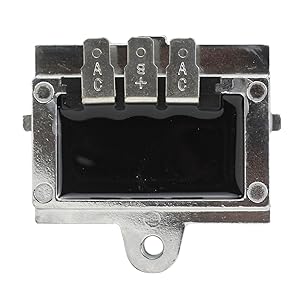
http://www.sonexaircraft.com/eshop/cart … ory_id=357
If the voltage regulator you received is identical in appearance to the ebay link you sent then it is almost definitely a different regulator design.
jwd3ca wrote:As I said, the Sonex wiring diagram shows that one AC tab is tied to B+. So I guess you could say that Sonex does say otherwise…
Are you referring to this wiring diagram?

If so, notice that the diagram matches the photograph of the voltage regulator Sonex used to use with the first two tabs connected, but not the one that you recently received.
jwd3ca wrote:So, assuming that the tied tabs are required (prolly for voltage sensing), what’s the best way to tie them. My first thought was a copper strip soldered to the two tabs, but I’m worried the heat required may be problematic. The other option is via wiring. Just wondering how those who have done it (successfully!) have done it. Thanks.
If you tie the tabs together on a regulator that isn’t designed to be operated that way, it won’t work. I would guess that nobody has successfully done it that way
Re: more AeroVee regulator discussion
Posted: Fri Aug 26, 2016 8:25 am
by jwd3ca
Ah, I now see what you were getting at, Chris: the previous generation of Kohel regulators came with the tabs bridged, from the factory. While the later ones don’t have that bridge. Neither of mine have the bridge, so I assumed that the wire diagram, which explicitly shows them tied together, meant the builder needed to accomplish this themselves!
I hoping Joe will jump in here with the definitive answer. Maybe my originally-not-bridged-but-bridged-by-me reg. will work fine w/o the tied tabs! Either that or I ruined it by following the wiring diagram 
Re: more AeroVee regulator discussion
Posted: Fri Aug 26, 2016 9:13 am
by jwd3ca
Here’s the new Sonex-supplied reg. No bridged tabs. My original one is identical.
Re: more AeroVee regulator discussion
Posted: Fri Aug 26, 2016 10:34 am
by gammaxy
jwd3ca wrote:Maybe my originally-not-bridged-but-bridged-by-me reg. will work fine w/o the tied tabs! Either that or I ruined it by following the wiring diagram
Yep, if the tabs are not supposed to be tied, it means there is a bridge rectifier inside. If you tie them together you are bypassing most of the rectifier circuit. I haven’t done a full circuit analysis, but I think there’s a good chance in this case that you didn’t permanently break anything.
Here’s a circuit that I suspect is similar to the design of the new regulators:
http://mastercircuits.blogspot.com/2010 … lator.html
This is a case where if you don’t think about it and just connect three wires to three tabs you should be able to swap one regulator out for the other style and never notice a difference. If the other style had bridged the tabs inside where you can’t see, we’d likely never even have this discussion.
Re: more AeroVee regulator discussion
Posted: Fri Aug 26, 2016 12:18 pm
by jwd3ca
Agreed. But I do think that Sonex needs to address this ambiguity. To me, that diagram says "Jump one AC tab to B+ (unless already obviously jumped)'. Just tried my ‘old’ reg w/o any bridging, only seeing battery voltage (12.3 12.4) at all rpms And I know I’m getting 30-40 VAC from the stator wires. BTW, using GRT EIS 6000. Will attempt to try the brand new reg this afternoon. To be continued… Thanks, Chris!
Re: more AeroVee regulator discussion
Posted: Fri Aug 26, 2016 5:05 pm
by jwd3ca
Installed new regulator. No joy. STILL seeing 12.3 @ 2000 rpm. Should be over 14 I have a dedicated case ground, so it’s not a grounding issue. Guess I better re-measure AC from stator, but it was over 40VAC previously, not holding my breath on that. GRT EIS measures bus voltage, has no relevant settings that I am aware of…
Re: more AeroVee regulator discussion
Posted: Fri Aug 26, 2016 11:09 pm
by gammaxy
I don’t know that 12.3 volts indicates you have a problem. While charging the battery, the voltage should take a while to reach 14 volts like the red curve at this link:
https://wiki.xtronics.com/index.php/Sealed_Lead_Acid_Battery_Applications
Also, you might double check the bus voltage with a known good multimeter and compare it to what your EFIS reads. Mine is off by ~1.5 volts for some reason.
That being said, you should see some jump in voltage as the regulator starts charging the battery. Were you also reading 12.3 volts before starting the engine?
My voltage seems to take 20-30 minutes of flight to stabilize at a peak value. I don’t know that I’d be able to draw many conclusions from running for a few minutes on the ground at 2000rpm.
Re: more AeroVee regulator discussion
Posted: Fri Aug 26, 2016 11:31 pm
by wlarson861
On starting my Aerovee I will see 12.3 to 12.5 volts until I reach above 2500 rpm at take off and in cruise.I don’t see the voltage come up for at least 20 min of flight. After an hour flight I see 13 to 13.5 volts so I know its fully recharged. I have never seen 14 volts on the MGL. It could be a calibration issue or just a quirk of the Aerovee. These alternators don’t produce much energy at low rpm, really need to be above 2500 rpm to throw off much juice.
Re: more AeroVee regulator discussion
Posted: Fri Aug 26, 2016 11:43 pm
by mike.smith
jwd3ca wrote:Installed new regulator. No joy. STILL seeing 12.3 @ 2000 rpm. Should be over 14
I’ve never seen 14v on the ground. I only see 14 to 14.2 after being in cruise flight for a while. I can run the engine up on the ground to full throttle and I would never see anything even close to 14v, so I don’t think measuring on the ground a low RPMs is telling you anything useful.
Re: more AeroVee regulator discussion
Posted: Sat Aug 27, 2016 7:41 am
by jwd3ca
Encouraging words, guys. Maybe I’m expecting too much too soon Thanks for your input. I’ll let you know as I prepare for the test flight.
Re: more AeroVee regulator discussion
Posted: Sat Aug 27, 2016 10:49 pm
by daleandee
Re: more AeroVee regulator discussion
Posted: Sat Aug 27, 2016 11:07 pm
by mike.smith
daleandee wrote:Hate to disagree with the others but you do have a problem. A fully charged 12 volt battery should read 12.6-12.8 volts before engine start. 12.3 volts shows the battery to be ~ 60% charged.
Yes, but you can get it back by putting it on the charger. The original question I thought, was whether there was something wrong if the voltage isn’t showing 13.5-14.2V at 2,000 rpm, which it won’t.
I went out flying this morning. On the ground it showed 13.1V before startup. Taxiing it was at 12.8. For the first 15 minutes flying it was 12.9. It wasn’t until I’d been flying 30 minutes that it showed 13.9. Another 10 minutes before it showed 14.2. During decent and landing (lower RPM) it showed 13.2 down to 12.9. I turn off the secondary ignition (AeroVee) during taxi, and it shows 13.2. If I leave the secondary on it shows 12.7 to 12.9. This has been fairly typical for the past 2 years and 200 hours.