My OneX with just under 100 hours total had developed an increasing indicated airspeed at stall. Initial flight tests had stall around 43 mph. Over the past year I have noticed the stall occurring gradually higher, first noticed at around 51, then 53, and this last month all the way up to 63. I also have a lift management system (angle of attack) installed so was not concerned about airspeed accuracy. Originally I had verified correct airspeeds inflight along side of our C172 and no adjustment to the Extreme was required. I have been suspicious of the MGL Extreme airspeed indication drifting higher.
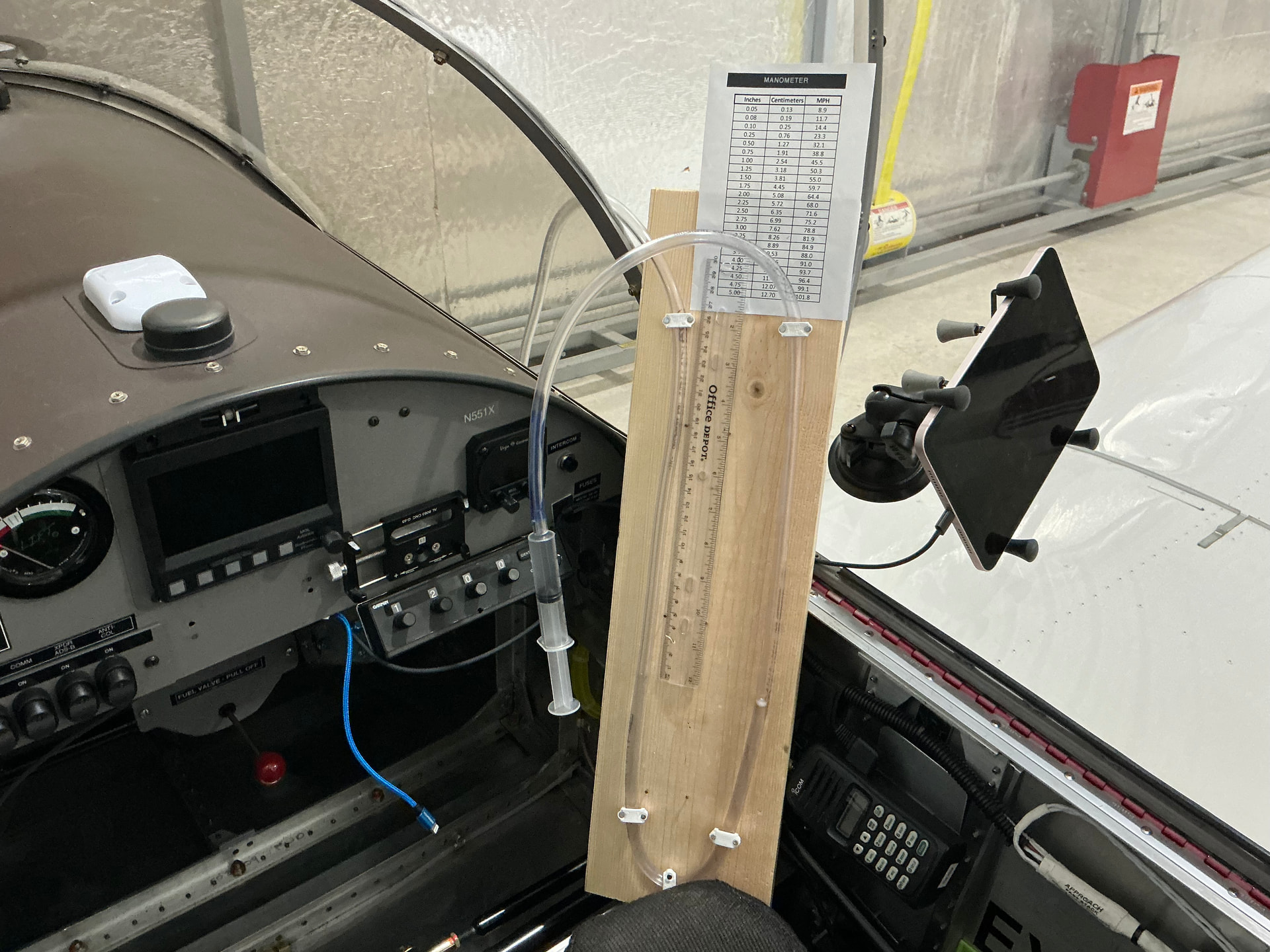
I assembled a DIY Nanometer out of tubing, syringe, staples, ruler, and a mounting board. Simple, took less than a half hour and used it today to check the airspeed calibration, which proved to be 20 mph high. The Extreme has a airspeed adjustment function in its menu settings. It took several attempts to adjust it properly but my final effort worked. Now I need to do a flight check to verify.
I didn’t have any food dye to color the water in the tube but it was still easy to see. The Nanometer readings to mph chart I found online and interpolated between numbers for more accuracy. However I found that not necessary. The ruler can be slide up or down for zeroing at the start. The key thing is after hooking everything up, balance the water level in both tubes with the syringe. Then gradually push the syringe in to increase the water level on the pitot side to the desired ruler reading, then compare that reading with the mph on the chart.
Just a w.a.g….thought?…there may be a degraded, or degrading tubing connection somewhere? would your testing be applicable to use the asi end of tubing to see if water levels remain constand over, say 10…15 min? if not, that might indicate a system leak somewhere? I have found leaks that way before.
Getting airspeed from first principles is laudable but iffy. It tends to be a highly nonlinear system. I am rooting for you, but GPS for calibration is likely a good idea.
We used to calibrate with a water manometer at Schweizer Aircraft. At Sikorsky we used electronic test sets. It works, but doesn’t account for pitot static position errors.
I am aware of the GPS method however, the only airspeed that was of concern was the stall speed. I guess I would have to be concerned about upper speeds for structural limits. I have read that the GPS method can also result in a lot of scatter data.
My main concern is why the MGL Extreme indicated airspeed began to drift upward in the first place, giving me less confidence in its built in airspeed sensor system. The work around would be a stand alone airspeed indicator, some would feel essential. Future flight tests will determine if the MGL Extreme airspeed indication continues to be unreliable. As far a system leaks, the airspeed was reading high, not low. There was no drift over time. A restricted static line could cause higher airspeed indication how ever faulty altimeter readings have not been apparent.
Having reread the MGL Xtreme operating manual, I am more convinced the indicated airspeed drift is a faulty internal sensor. The factory precalibrated the unit and noted the correction value on the back of the instrument. During initial flight testing that setting was verified as accurate.
My recent adjustments had to deviate significantly from that original factory value to get anywhere close to correct ASI.
So a flight test is in order to see it is close to being accurate or continues to drift out of accuracy. A work in process.
Tom Helm
Interesting. Under other circumstances, this would be a very absorbing puzzle but I suspect you would rather not be so entertained. I wonder if a leak in the static line could cause a high airspeed reading by pulling static low due to lower pressures in the cockpit.
Interesting, I just read that MGL Avionics and Michigan Avionics has ceased operation.. looks like am on my own for any future MGL Avionic issues
I also reviewed my procedure for using the Manometer and found I was reading it incorrectly. I was using the column rise measurement, rather than the total measurement between the fluid up and down movement. So I did the calibration again today. It appears that depending on any pressure difference in the system when the airspeed calibration is zeroed might affect the slope of the correction settings. I had to do the calibration multiple times to get numbers to match as pressure was increased.
I’m finishing my Smex A, and building my instrument with an AV30 EFIS and a gauge anemometer from a glider as backup. Using this setup, besides being sure to have airspeed in case of EFIS failure, you can see if only one is giving false reading or is the complete setup defective.
I recently added an AV30E to my plane but I have an MGL Flight 2 instrument also. But during the build I installed an LRI (lift Reserve Indicator) and while it doesn’t give an airspeed it gives excellent information should the ASI ever fail. By viewing the LRI I know when I’m at flap speed, approach speed, & stall speed although I don’t have an exact number to go by. It’s an awesome instrument!
Mine is similar to this (I have a different probe) -
On my aging Kitfox, I had a sudden change in airspeed indication (started to read very low). On trial & error trouble shooting, I tracked in down to a failed plastic tubing connector for the pitot tube inside the wing.
I discovered what has caused the indicated airspeed drift on my OneX. With a borescope, I looked behind the panel and found the static line disconnected from the MGL Xtreme EFIS. Fortunately during the build I had decided to make the glare shield removable instead of riveted as per the plans. Good thing because I have had it off several times since, including now to reconnect the static line. The vacuum hose I had used for the hook up to the EFIS was marginally snug enough to avoid slipping off if disturbed.
Thought I figured it out, but still had low IAS indication. I disconnected the pitot tube from the tubing on both ends and blew out with air compressor set higher. My Manometer now indicated IAS accurate, test flew, IAS now indicated 20 slow. On ground I restarted Xtreme and zeroed the airspeed menu. ( might have been some prop blast). Flew again and IAS improved, now only about 10 mph slow. In the hanger now, reset airspeed to zero, no wind or prop blast.
Intended to test fly today but now have ignition problem. Started with #4 cylinder (secondary ign) so back to hanger to check plugs. Plugs were fine. Checked plug wires, then started again and now have #3 and #4 cylinders (secondary ignition) not working.
So now I have a question to those who have had secondary ignition coil problems. In my case one plug on each coil not working. Has that been common with coil failures, just one plug and both nearly at the same time?
I’ve had one secondary coil failure. Would fire one plug but not the other as verified using EGT. I replaced both coils then. Probably 300-something hours of time on them.