So I bought a beautifully built Sonex last year. With only 50 hours on it, the #3 exhaust valve was already trashed. I had a friend help me to install brand-new Empi heads.
The overheating problem frustratingly and annoying continues. Before I trash another valve, I’d like to know if the factory-designed baffling system offers adequate cooling, or does everyone have to create and make their own mods? I just had an A&P friend help to re-do the rubber baffling, and now it’s running hotter than ever. I can’t see how to avoid leaks around the seal when there are so many 90 degree bends in the baffling.
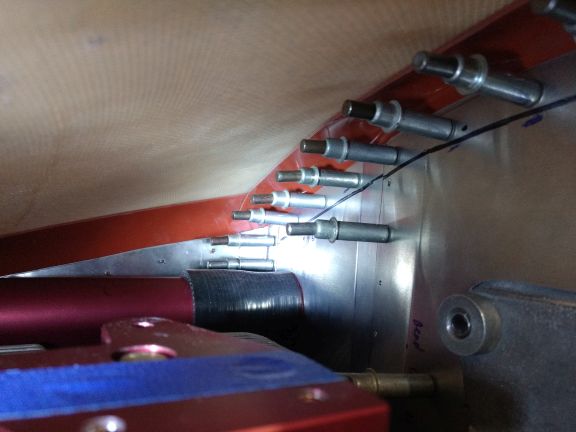
This is how it should look, in my opinion. The corners are free. I think it seals fine with the rear seal over or under the side seal. Typically I put the right side on first, and give the rear seal a tug to make sure it’s going the right way. Then it behaves.
When I had my Aerovee Sonex, which I traded in for a Citabria a couple months ago, I always had heating problems, even though I tried my damndest to block all the holes that would divert cooling air from the heads, and adjusted air inlet and outlet vent sizes. Typically, in an 80 degree f day, the cht would get to about 410 f on climb out, then, by judicious adjustments of mixture, rpm, airspeed and rate of climb, I could get it to stay just under 400. After about 20 minutes flight time, by judicious adjustments of those variables, I could keep it down to 375 or thereabouts. I could keep egt down to around 1350 with mixture. Oil temp generally ran around 165 ( bottom mounted oil cooler). When mosaic was approved I decided to go for a certificated bird.
Flying an Aerovee or any VW conversion, it is just the nature of the engine and keeping the heads cool is a direct inverse relation to how long they will last before valve work.
CHT’s below 300F and your heads will last 200-300 hours before valve work is needed. Mine with stock baffling (nowhere near as nice as Brian’s) I see 350F in cruise on hot days and 300F this time of year. Of course it all depends on where the temp sender is located. Mine are on the flat face about 1/4 inch up and to the side of the plug hole. If you are using ring terminal senders around the spark plug you will typically see 50F hotter temps.
Keep in mind VW originally designed the similar fin area heads to work on 1200cc beetles and the largest that came out of VW with this similar head is 1600cc. We’re now at 2180cc on the Aerovee.
The Aerovee is a reliable and cost effective engine to maintain. I’ve had to do top overhauls about every 400 hours on a Lycoming on a previous airplane and I much prefer doing valve work on VW heads, labor and cost wise!
Hot cylinders have always been a bit of a pain on AeroVee’s, especially during climb. I always found there are three things to check and consider:
Mixture: Make sure the engine isn’t overly lean, especially on full power climb. You should hopefully see EGT reading in the 1150-1200 degree range on climb. If you see EGT’s higher than that, you may need to enrichen your needle a bit.
Secondary ignition timing: Make sure your secondary ignition isn’t advanced which will cause high CHT’s. Check your timing in cruise by setting power and comparing CHT’s when you turn off one ignition system at a time (not both at the same time please) and comparing CHT’s.
Ensure you have tight silicone baffling around the engine that contacts the cowling and make sure the cooling exit area hole at the bottom of the cowling is large enough to allow air to get drawn out of the cowling. When I had my AeroVee I went from around 50 sq/in exit area to around 80 sq/in and enlarged the exit ramps to help draw air out of the cowling. That made a difference!