Glide Ratio
Posted: Tue Nov 15, 2022 10:01 pm
by Skippydiesel
My aircraft, Sonex/ Rotax 912 ULS, is due to have its pre test flight inspection this coming (Australian) Saturday morning. One of the inspection forms calls for an, engine out, glide ratio.
I would like to enter a nominated (conservative) glide ratio that can be adjusted after flight testing - please advise me of your aircrafts glide performance.
My thanks in anticipation.
Re: Glide Ratio
Posted: Tue Nov 15, 2022 11:48 pm
by pappas
Optimum conditions suggest 11:1. This number is also published in several web search results.
Re: Glide Ratio
Posted: Wed Nov 16, 2022 12:10 am
by Skippydiesel
pappas wrote:Optimum conditions suggest 11:1. This number is also published in several web search results.
Thanks Pappas - looked on the Sonex site - no mention that I can find.
Re: Glide Ratio
Posted: Wed Nov 16, 2022 1:56 am
by gammaxy
Edit: I removed my estimated performance from memory of 8.5:1 since I posted actual data further down that shows closer to 9.5:1.
I found this POH online that lists a best glide angle of 6 degrees which works out to 9.5:1.
https://www.sonex883.com/docs/Sonex%20p … rating.pdf
My experience has been that the Cessna-172 seems to glide noticeably better.
Re: Glide Ratio
Posted: Wed Nov 16, 2022 6:59 am
by fastrichard
That’s an interesting question. I am a long way from having the airplane ready for flight test. Do most people actually measure Vx, Vy and glide performance during flight test? Or, do most people just kind of do a subjective evaluation of how the plane flies and call that good? The relevant test cards on the EAA recommended test program would be cards #7 and #8. Both The Sonex site and Wikipedia list 11:1 for L/D.
Re: Glide Ratio
Posted: Wed Nov 16, 2022 7:10 am
by Skippydiesel
I suspect hat there is a significant difference between engine out and engine idle glide ratio.
I hope it never happens but the engine out glide ratio is the important one, as this is what will give the potential to reach a suitable (selected) forced landing site rather than a crash (no option) landing. The former being the most likely to be survivable.
Re: Glide Ratio
Posted: Wed Nov 16, 2022 8:06 am
by GraemeSmith
The little charts in the Cessna Owners Manuals are quite conservative. A blend of reality, flight testing and the company attorneys wanting to be a little conservative (source - Aviation Attorney Rick Dirden who used to work for Cessna).
I can tell you I used to “beat” the Cessna chart with my 150 relatively easily. But in a 150 - Vg and Vminsink are within a knot of each other with very little difference for load. Stopped propeller compared to windmilling improves the glide substantially. On the day it mattered - I managed a glide of 12 miles when the little chart said I had 10 miles in the “glide tank” and made the runway with 1,000ft to spare.
–
Testing in my Legacy Sonex - the wing is MUCH more critical of angle of attack and loading. Flying full fuel, just me - so about 150lb of usable remaining and windmilling prop. I measured 8.8:1 fairly consistently at 60KIAS. The sink rate is in the area of 500fpm. BUT it requires a HIGH degree of concentration to maintain that angle of attack and as you are likely to be engaged with other things like trying engine restarts, looking for a spot to land and making calls - I use 8:1 as a “real world” number. Even then - when I practice “cold” having not done it for a bit - sometimes I will only achieve 7:1.
To my mind “real world” is much more important than a measured “perfect” value - so I am back to the Cessna chart in terms of thinking. “Most people should manage this - though the plane will do better”. To be clear - I don’t use the Cessna chart!! Just the mindset.
Rule of thumb for quickly establishing Vg in an emergency - in level flight - put the chord line of the wing parallel to the horizon. Gets you close enough - and helps when you are having to look outside - rather than at the instruments.
Re: Glide Ratio
Posted: Wed Nov 16, 2022 10:33 am
by Bryan Cotton
Jeff Schultz posted data:
http://sonex604.com/
I used his cards to fly Vx and Vy. I haven’t done the glide performance yet. But you could use his logged numbers to build a glide ratio chart.
Re: Glide Ratio
Posted: Wed Nov 16, 2022 3:22 pm
by gammaxy
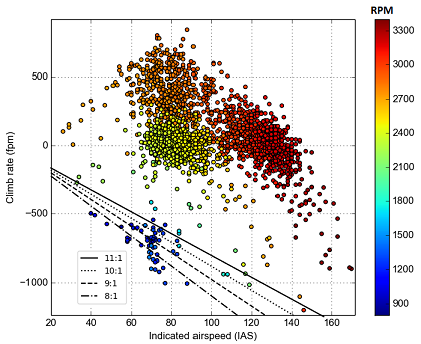
I wrote a script to parse through most of my Phase 1 data, find periods of unaccelerated flight and plot points showing engine RPM, IAS, and climb rate.
The data is very raw and I made it many years ago. It includes the full range of weights. A huge range of altitudes, etc. I’m hesitant to share it because of these caveats, but I like it because it shows a range of possible values with little room for exaggeration.
I’ve overlaid some glide ratios on my old plot. Notice how they compare to the blue points at idle. On my airplane, 11:1 would be an outlier. There’s a pretty dense set of points on the 9:1 line probably from most of my glide testing and power off landings at <3500 feet. If you adjust IAS to TAS, these points probably move right a bit possibly to 9.5:1 or so. It’s likely the lower blue points are from long descents from high altitudes and should have significant higher true airspeed, so I think they can be ignored.
climb_rate_vs_ias_with_glide_ratio_60.png (91.97 KiB) Viewed 2914 times
Re: Glide Ratio
Posted: Wed Nov 16, 2022 7:37 pm
by ldmill
General rule of thumb for my legacy Waiex with Jab3300 and a weight around 1070 lbs (me and full fuel load) is 1 mile glide for each 1000’ above the ground with an idling prop for about about 10:1 - and probably 3/4 of that (about 8:1) with a dead engine. This at 70mph.
I figure that’s about all I’ll actually be able to remember given the situation…/
Lorin
Re: Glide Ratio
Posted: Wed Nov 16, 2022 9:35 pm
by Scott Todd
I may be a bit rusty on the math but a statue mile is 5280 feet. So from 1000’ above ground, that works out to about 5:1. If the prop stops, it gets better, not worse. A windmilling prop at idle is more drag than a stopped prop.
Re: Glide Ratio
Posted: Thu Nov 17, 2022 12:18 am
by Skippydiesel
Thanks for all the feedback.
Sonex has written to me with a 11:1 glide ratio.
After reading all of your suggestions I have decided to go with a conservative 8:1. The reasoning (hopefully sound) is two fold:
My EFB “OzRunways” has a glide distance ring, around the aircraft icon, that relates to the ratio that I have entered.
The above ring would add to my decision making, achievable landing sites, in the event of an engine out forced landing.
Re: Glide Ratio
Posted: Thu Nov 17, 2022 1:40 am
by gammaxy
Sounds reasonable. I think you can be reasonably confident it will be at least that good.
I’ve shut the engine down several times in flight. Early in Phase 1, the propeller stopped pretty solid and I dove to 90+mph and couldn’t get it to windmill. More recently, the engine seems to want to windmill and would take some effort to get it to actually stop. So, I’m not sure I have a good way currently to test the engine-stopped configuration to see if that gets me to 11:1.
I imagine the Xenos guys might have some useful insight to the propeller stopped vs windmilling question. I wonder if your longer propeller will be noticeably different.
Re: Glide Ratio
Posted: Thu Nov 17, 2022 2:55 am
by sonex892.
Not surprised people are only getting 8:1 glide ratio when using a glide speed of only 60 kts. I found the best glide to be a bit above 70 kts or 80mph. The slower the sonex gets below 70kts the steeper the descent angle becomes.
Re: Glide Ratio
Posted: Thu Nov 17, 2022 3:28 pm
by N190YX
I “believe” the glide ratio is better with a stopped propeller versus a windmilling propeller, because a stopped propeller creates less drag. Anyone know if this is true?
Re: Glide Ratio
Posted: Thu Nov 17, 2022 7:36 pm
by GraemeSmith
sonex892. wrote:Not surprised people are only getting 8:1 glide ratio when using a glide speed of only 60 kts. I found the best glide to be a bit above 70 kts or 80mph. The slower the sonex gets below 70kts the steeper the descent angle becomes.
OK - I’m going to go out and try that again. I found 70KIAS was costing me more than 60KIAS. Wonder how much the stopped prop helps get 11:1? Did Sonex give a suggested speed to get that 11:1 and a loading they did it at?
N190YX wrote:I “believe” the glide ratio is better with a stopped propeller versus a windmilling propeller, because a stopped propeller creates less drag. Anyone know if this is true?
Correct.
The rubber band scale model endurance guys figured this out years ago. When the twisted rubber is expended - stopping the prop got you more time aloft.
There is a reason you feather the prop on a twin when an engine fails. The feathered prop stops spinning and presents a lot less drag than the windmilling prop. It’s not JUST about presenting the edge and narroeer profile to the air.
I’ve measured it in a C150. Comparing glide ratios with a windmilling prop and a stopped prop. You go a lot farther on the stopped prop.
BUT
Getting the prop to stop can be problematic.
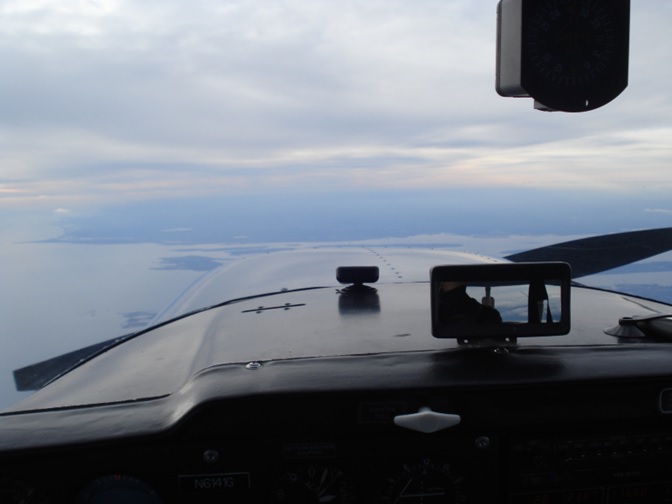
7,000MSL, Airport below on a quiet day.
stoppedprop.jpg (48.15 KiB) Viewed 2302 times
Unless the engine destroyed itself in a manner that did it for you. I had to pitch up very aggressively and fly WAY below Vg to get the prop to stop. And during that pitch up - the VSI was unwinding downhill like crazy. At the <10,000ft altitudes we fly these little planes at - stopping the prop will cost you more than you will gain. Above 10,000ft - I think I would want to go out and measure it all again to find when it was worthwhile.
(The exercise of stopping the prop was also to see how much of a dive was needed to get it to spin again and so air-start the engine. Interestingly at higher altitudes it took significantly less of a dive (500ft at 8,000ft) to get the engine to run again compared to lower down (nearly 1,500ft down to 2,000ft MSL). Not quite sure why except perhaps having to compress thicker air in the cylinders required more energy by diving the plane faster)
Re: Glide Ratio
Posted: Thu Nov 17, 2022 9:44 pm
by ldmill
Scott Todd wrote:I may be a bit rusty on the math but a statue mile is 5280 feet. So from 1000’ above ground, that works out to about 5:1. If the prop stops, it gets better, not worse. A windmilling prop at idle is more drag than a stopped prop.
Yep - that’s what I get for multi-tasking and not paying attention to my typing fingers… 2 miles for every 1000’ above ground, or somewhat above 10:1… I also agree with you on the stopped prop vs. windmilling, I just tend to plan ubber conservative when pondering things going quiet up front.
Thanks Scott!
Lorin
Re: Glide Ratio
Posted: Fri Nov 18, 2022 2:26 am
by gammaxy
sonex892. wrote:Not surprised people are only getting 8:1 glide ratio when using a glide speed of only 60 kts. I found the best glide to be a bit above 70 kts or 80mph. The slower the sonex gets below 70kts the steeper the descent angle becomes.
So… you inspired me to go out and try 80mph today (thanks for the excuse to fly). First, I flew a calibration triangle at about 75mph so I could attempt to determine a correction for my IAS. I then flew 70, 75, and 80mph IAS descents. I got the best glide ratio at 70mph IAS, but when I came back to crunch the numbers I am getting a ~10mph error after also accounting for wind. It’s possible my 70mph IAS is really 80mph TAS (which might agree with your observation), but I probably need to investigate further. I am pretty confident that my IAS is reading low, though, just not sure I believe it’s really 10mph low.
So my best glide today seems like it was 627fpm at 80mph TAS which works out to a glide ratio of 11.2. I kindof feel bad for advocating for lower numbers if this is correct.
I also tried to glide with the engine off, but couldn’t easily stop the propeller, so don’t have any data there.
Re: Glide Ratio
Posted: Sat Nov 19, 2022 2:20 pm
by GraemeSmith
A “Quick and Dirty” air test this morning in cold hard and smooth air. Basically one shot at each speed. To look for a trend. High concentration to stay on speeds - so way better than a “real world in anger” number.
The “Rule of Thumb” to put the chord line parallel to horizon was at about 65-70KIAS. These are quite different numbers than I got in summer heat and much better. This was in KNOTS not mph. Calculated as such.
Aircraft was at ~950lb Gross
VgTest.jpg (27.27 KiB) Viewed 2140 times
Re: Glide Ratio
Posted: Sat Nov 19, 2022 4:49 pm
by Skippydiesel
Very good Graeme. very close to Sonex official 11:1. Achieving this in nice cold/dense air will likely result in slightly lower performance in your summer months.
I assume Sonex derived their glide ratio with the aid of optimum climatic conditions, a light aircraft & a “top gun” pilot .
My glide ration is for entering in to my POH & EFB and will have to accommodate all seasons, pilot detractions, aircraft loading & prop turning/not situations, so I think I will stick with the ultra conservative 8:1, at least until I can demonstrate to myself that I can easily better this.
Re: Glide Ratio
Posted: Sat Nov 19, 2022 5:18 pm
by GraemeSmith
I see your autocorrect keeps wanting to make “ratio” into “ration”. Mine does too!
I need to go fly this again and get a bigger data set and plot this again. It is distinctly different than when I measured in summer temperatures but with the aircraft at the SAME load condition and Density Altitude AGL.
Because there is Vg and there is VMinSink (which the glider guys use to loiter while looking for lift). They are usually different and that quick dataset from today doesn’t show it. On these short stubby wings they may well be almost the same - I know when I did it extensively with my 150 there was only about a 1 knot difference - which was way within the margin of pilot error.
I’ve shot a note to a mathematician/aerodynamicist to try and glean why I got different answers at the same DA but different temperatures.
–
Any Onex owners or glider pilots who know the answer about different Vg for different seasons but same DA?
Re: Glide Ratio
Posted: Sat Nov 19, 2022 5:52 pm
by Bryan Cotton
I hope to get this dataset within the next month as well and I’ll share. I am going to re-fly my Vx/Vy card (Thanks Jeff and sonex604.com) and add the glide stuff in too.
I am not sure why the same DA but different temps give different numbers. I am a former glider pilot. The one thing I can tell you which may be confusing, is you fly faster into the wind and slower with the wind for best glide. For the non-glider pilots flying at best glide is probably good enough, unless it’s really windy and you are trying to go upwind. Then you add about half the winds speed to your glide speed.
Re: Glide Ratio
Posted: Sat Nov 19, 2022 11:53 pm
by dbdevkc
I’m a glider pilot also - and you are correct about changing speed when flying into a headwind vs tailwind, and that matters when the rubber meets the road and you’re in a situation where you need to glide as far as possible. But you need to start with the correct IAS for the plane. 10 kns off either way will make a huge difference in sink rate and glide ratio. Obviously I’m not flying yet but part of the plan is to get the baseline for my airplane (which if I were a betting man will be different than a factory airplane) by flying some early morning when there is no convection yet and very little wind aloft and track altitude lost over distance at different speeds, repeat in different headings, etc.
Re: Glide Ratio
Posted: Sun Nov 20, 2022 12:53 am
by Bryan Cotton
dbdevkc wrote:I’m a glider pilot also
What club? I used to be in Nutmeg Soaring. They were at Candlewick Farms in New Milford, CT until they got kicked out. Then we bought Freehold airport south of Albany/North of the Catskills.
Re: Glide Ratio
Posted: Sun Nov 20, 2022 10:16 am
by dbdevkc
Valley Soaring Club, Randall Airport, Middletown, NY. I think you know Dave Matuska from Sikorsky, he is a member of our club.
Re: Glide Ratio
Posted: Sun Nov 20, 2022 12:54 pm
by Bryan Cotton
dbdevkc wrote:Valley Soaring Club, Randall Airport, Middletown, NY. I think you know Dave Matuska from Sikorsky, he is a member of our club.
I know him well! Say hi for me.
Re: Glide Ratio
Posted: Mon Nov 21, 2022 7:41 pm
by GraemeSmith
So I posed the question about the different numbers I got in the summer and the winter to a friend.
His qualifications include a very experienced glider CFI. He ran the aviation program at Daniel Webster University back in the day and one class he regularly taught was to take their Cessnas out and measure the performance numbers from scratch (in effect Phase 1 testing them) and now he is a senior FAA Inspector. His response was:
S wrote:It would be hard to find something very direct, but there could multiple factors at issue.
- Variations in testing procedure, even if not specifically noted, such as rates of deceleration, or acceleration in the test procedure.
- Published speed are usually a line of best fit for multiple tests conducted in various conditions. One or two tests does not necessarily mean there is a significant difference. In fact I used to teach a class on determining aircraft performance, and we had students do some basic testing in various aircraft. We would get some significant variations from time to time – including discovering that there were some install issues in a particular Cessna 152.
- Calibration issues – Usually are bigger and have more factors than people will give credit to….
a. Do you have an electronic airspeed indicator? Does it account for temperature difference. Does temperature have an effect on the circuit boards and digital pickups? You would know this better than I, but I would suspect these could have an effect, especially in Experimental equipment that may not meet the TSO requirements.
b. Mechanical Operations – Pitot tube (and Static) material throughout the aircraft, does it expand or shrink based upon temperature? Remember most of it is in an area that is not heated or warm – I.e. it all at 80+ degrees in summer, but likely at or near zero in the winter.
c. Instrument error with Temperature – Mechanical instruments – no matter how precise, also have some error associated with temperature. I am sure diaphragms, gears etc shrink or are slow to react when colder. Remember – even if the cockpit is “Warm” it is likely that instrument was cold soaked and is in a portion of the panel that is not all that warm. It took years, but we finally got temperature corrections on approaches (although still in a messy calculation process). I could easily see some of the same factors applying to airspeed indicator.- Density altitude – Be are that moisture plays a bigger role in Density altitude than we give it credit for. You can easily get a 3% difference just with variation in moisture. In addition, recognize that the atmosphere is not “linear”, seeing the difference in temperatures at the surface and then the small variation in MSL altitude tells me that you likely had a temperature inversion you were dealing with in the winter. This could play a factor.
- Airspeeds – Remember there are variations in change of airspeed (KIAS, KCAS, KEAS, KTAS) etc. In fact more electronic panels, because they can calculate calibration and “compressibility” effects give the Indicated Airspeed displayed to the pilot as KEAS – the Eclipse 500 did this. There are also things that we measure in TAS, but pilots think of in terms of IAS. I do not recall if this is the case with glide speeds, but it does play factor in other speeds, like VA/VNE. In fact I did a webinar on this subject, as more people fly higher (like Gliders in Mtn Wave) or add turbo charging (Hmmm….Sonex engine or Jet) that they can easily exceed VNE without realizing that they actually are.
a. https://www.youtube.com/watch?v=q9TNBU8BryUSo those are just a few thoughts. Not 100% sure, but could see so many reasons.
And my thoughts back:
Graeme response wrote:I suppose my thoughts and questions back include:
I don’t trust the VSI implicitly as mine is electronically derived/computed. I also measure altitude lost over time. – which over 2,000ft is going to be a 3-4min period. That is a decently gross amount of altitude to get repeatable numbers. I also avoid starting measurements until airspeed is stabilized for about 15 secs.
The point about instrument error – especially temperature related I had considered. It’s an interesting issue. Even the MGL avionics try and temperature compensate. But from the bottom end. The units - including the remote mounted critical AHRS module and magnetometer – include heaters to get the chips up to a minimum temperature before they will deliver answers. But in the summer there is no cooling to a regulated temperature – so the room for error exists.
Getting the plane to fly exactly on aTTitude is difficult. Even well trimmed in very smooth air – it is a tough gig. The plane is very short coupled. Another pilot who I am comparing notes with is even trying to differentiate the CG location because that drives the elevator position for trim and changes the drag. His plots demonstrate a very sharp peak optimal “tip” – instead of the more rounded peak you get on a Ce$$na. It’s really had to fly that “tip” precisely.
DA affected by moisture. Yes – but I thought that was compensated for in the DA calculation – taking account of temp and dewpoint?
But I hadn’t fully considered the possibility of inversions. Guess I’m going to have to add temperature measurements at each altitude to ensure that the lapse rate is valid that day.
VNe – Isn’t the airframe stressor here the aerodynamic forces – rather than the TAS? Air gets thinner, IAS drops though the plane still has a higher TAS. But the TAS can’t harm the plane as such. There is less air and aerodynamic effect acting on the airframe. So VNe would be IAS? No? Though I can see that you could do harm pulling G’s as that is relative to the TAS and the earth’s gravitational pull…..
The old “rule of thumb” of putting the chord line parallel to the horizon – definitely gets you in the ballpark – and if you were flying it in anger, and looking around for a field and and and…….. it’s probably a good way of getting close.
Re: Glide Ratio
Posted: Mon Nov 21, 2022 9:00 pm
by GordonTurner
Vne is mostly a flutter problem. Flutter is excited by velocity, not density, so the actual Vne is really a TAS. This is inconvenient to display on a steam gauge airspeed indicator (turbine aircraft have a moving redline), so typically a conservative IAS is marked based on the highest altitude the plane is expected to be flown at. Gliders on the other hand, typically have sea level IAS marked but with a chart showing the reduction in IAS for Vne as altitude increases.
Gordon
Re: Glide Ratio
Posted: Tue Nov 22, 2022 3:59 pm
by Bryan Cotton
Here is my data from today. I am really suspicious of the 60kt point as I my idle is set too low and I was trying to set a consistent RPM by hand. I think once I get the idle stop set better I can get better data. Also it really appears I need to go higher than 84kts to get a full data set. Takeoff was at 1083 lbs. This brings up another point - best glide speed is a function of weight, because it is dictated by angle of attack. So at some point I need to do some light weight testing and some heavy weight testing to get a better polar and correction.
Waiex 191YX glide data 11-22-22.png (22.69 KiB) Viewed 2206 times
Re: Glide Ratio
Posted: Wed Nov 23, 2022 9:32 am
by GraemeSmith
Bryan Cotton wrote:Here is my data from today. I am really suspicious of the 60kt point as I my idle is set too low and I was trying to set a consistent RPM by hand. I think once I get the idle stop set better I can get better data. Also it really appears I need to go higher than 84kts to get a full data set. Takeoff was at 1083 lbs. This brings up another point - best glide speed is a function of weight, because it is dictated by angle of attack. So at some point I need to do some light weight testing and some heavy weight testing to get a better polar and correction.
Waiex 191YX glide data 11-22-22.png
Yeah - that “60” looks a little suspect.
One thing you can do to “imitate” a stopped prop is to set an idle in the 800-1,000 range - find the rpm where it “just” contributes thrust. That “very slightly” thrusting prop will imitate a stopped prop as the tiny bit of thrust is better that the drag of a windmilling non powered prop. If you see what I mean.
And yes - need to try different load factors.
Re: Glide Ratio
Posted: Wed Nov 23, 2022 11:03 am
by pappas
I found through my, likely loose, phase 1 testing on both of my Waiex’s, (3300 and AV Turbo), that my best glide and minimum sink were within about 2-4 mph of each other between 78 and 82 MPH. I was usually able to get closer to 11:1 than 8:1.
I also found that in actual, coming down right now, flight conditions and with decisions and distractions, I was only able to reliably keep the craft at about 80 mph indicated. I couldn’t keep it pegged at exactly 78 or 82. However, because they are so close to each other it really didn’t matter for me.
I started flying in 2-stroke powered Rotax ultralights so I have quite a number of quiet engine experiences in 34 years. But only one in the Waiex.
Luckily, I have always found that whatever glide ratio I was able to achieve, it was sufficient to get me all the way to the ground!
Stay safe.
Re: Glide Ratio
Posted: Wed Nov 23, 2022 3:51 pm
by Bryan Cotton
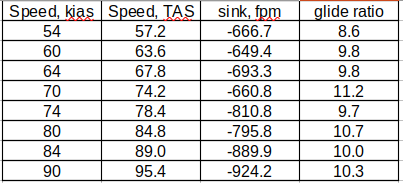
Here is a better data set. I flew over the airport, and pulled to the idle stop except at 64kts and below. There I adjusted to maintain between 800-1000 rpm.
Note I used Jeff’s spreadsheet so this is corrected for density altitude and true airspeed. It was nice and smooth today with an inversion. It was 4C on the ground and 8-11C during my flight. Hazy down low.
Waiex 191 glide data 11-23-22.png (16.07 KiB) Viewed 2040 times
Re: Glide Ratio
Posted: Thu Nov 24, 2022 2:09 pm
by dbdevkc
If I am remembering correctly, the speed at which you achieve your best glide ratio varies with the weight. So although ~11 might be the best glide ratio, since the weight of our individual planes might vary considerably from each other so our best glide speeds to achieve that ~11 will vary as well.
I think most of us understand that is the case with stall speed, but with best glide ratio speed it is not as intuitive.
Re: Glide Ratio
Posted: Thu Nov 24, 2022 2:32 pm
by Bryan Cotton
dbdevkc wrote:If I am remembering correctly, the speed at which you achieve your best glide ratio varies with the weight. So although ~11 might be the best glide ratio, since the weight of our individual planes might vary considerably from each other so our best glide speeds to achieve that ~11 will vary as well.
I think most of us understand that is the case with stall speed, but with best glide ratio speed it is not as intuitive.
From the previous page of this thread:
Bryan Cotton wrote:This brings up another point - best glide speed is a function of weight, because it is dictated by angle of attack. So at some point I need to do some light weight testing and some heavy weight testing to get a better polar and correction.
Edit: there is a lot to learn about this by flying gliders. If you are flying into a headwind, you fly faster. If you have a significant tailwind, fly slower (but not slower than minimum sink). If you are in an airmass with a lot of sink, fly faster to get out of it quickly. If you are in lift, fly slow (but not slower than minimum sink).
Based on my polar data so far, 80 would be a good speed to shoot for, and I could optimize if I had time to think about it. There is not a huge penalty for flying 80 or 90 kts at the weight I was at.
Re: Glide Ratio
Posted: Mon Jan 09, 2023 7:57 am
by GraemeSmith
Just to comment on something I said previously. I stated putting the wing chordline parallel to the horizon would achieve something close to Vg.
In her column in the Feb 2023 edition of AOPA Pilot - 2022 CFI of the year Catherine Cavagnaro calls out this “rule of thumb” as being wrong. And in some cases dangerous.
I then went digging again to find out what had prompted me to this belief. I was fairly sure it was in the Handbook for Naval Aviators. And though I have completely re-read that whole piece again I can’t find that reference.
Interestingly the handbook has an extensive discussion about how critical it is to maintain Vg and suggests that +/- 5% of the optimal Vg airspeed will not make a whole lot of difference to the glide ratio achieved. At least “in the heat of the moment”. If all else fails the chapter repeatedly emphasizes the need to eject if things are headed south!
So - let me modify:
I have found the placing the chordline of the wing of my Sonex - parallel to the horizon will get me close to Vg. But this is not a hard and fast rule for all aircraft and not to be relied upon