First I want to say that this sounds really strange - I agree.
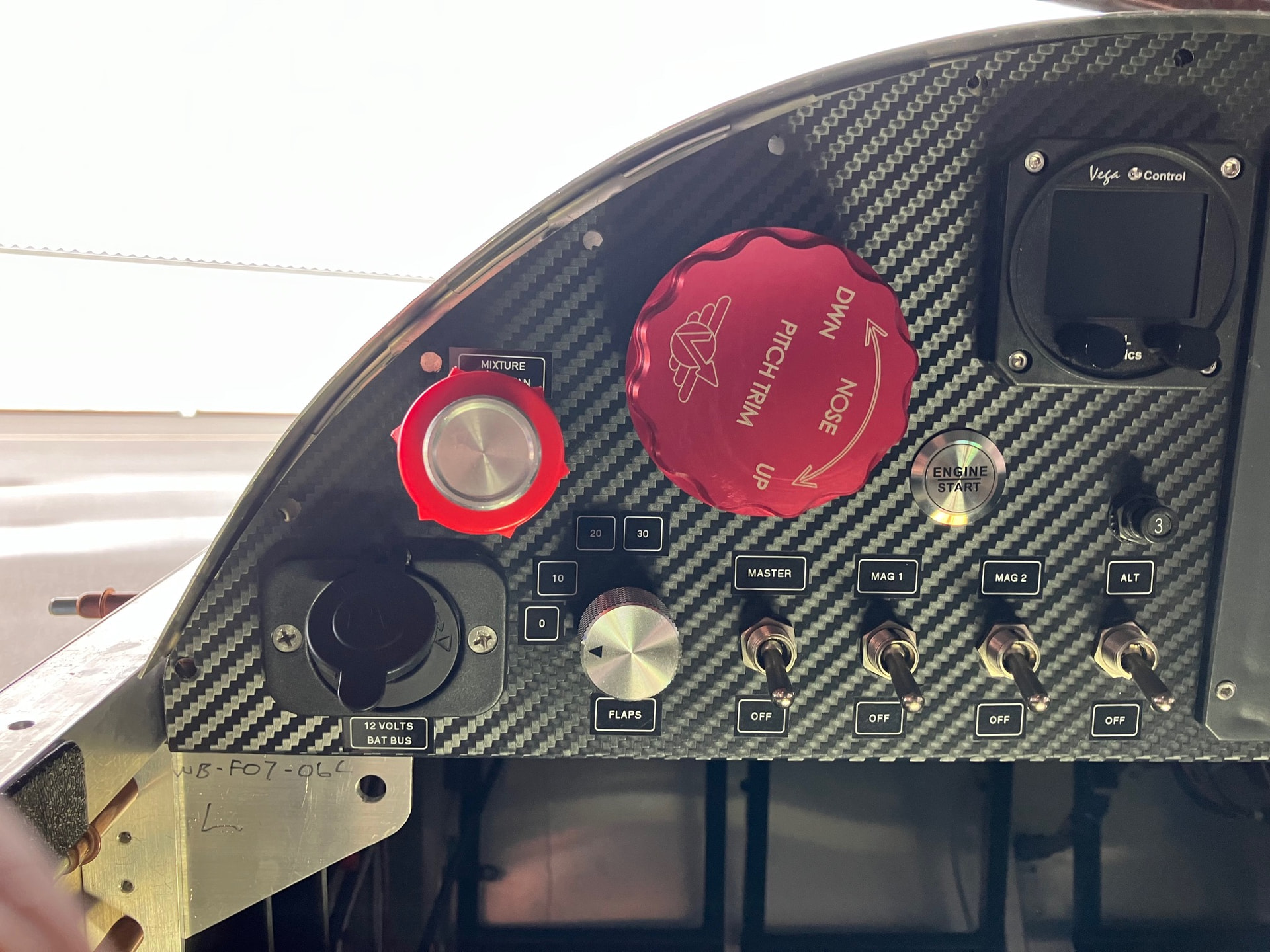
I have an MGL Gen 3 iEFIS Lite, SP-10 Flap controller, and a rotary switch on the IP for the flap position - 0, 10, 20 & 30 degrees. I have 65 hours on my Waiex and the flaps have worked flawlessly during those 65 hours - after the factory replaced the flap motor that came with the kit - DOA. I could control the flaps with my rotary switch or the EFIS soft button - both worked well.
Yesterday I was flying, and all of a sudden the flaps actuated and went to 10 degrees. I tried to reset them with the rotary switch - no joy. So I used the “Up” button on the EFIS for the flaps and they went back to 0 degrees. A few seconds later it happened again. This continued until I landed.
I pulled the switch out of the IP - it looked perfect - no loose wires, etc. Re-installed the switch and cycled the flaps 5-6 times in the hangar - worked perfectly. So, I decided to try another flight. As I was taxiing out to the runway - the flaps clycled down to 10 degrees again (I takeoff with 0 degrees flaps). Again, I had to use the EFIS “Up” button to get them to retract.
We have the next chapter in this story. A new robust switch from Digikey (P/N: GH7287-ND) has been installed. I verified that the wiring is properly restrained, no loose connections and no shorts to ground. During my flight this morning - the flaps began to move randomly again - same problem. I could see the flap indicator on the EFIS flashing, meaning that the flaps were moving. I could also see the flaps moving randomly between “Flaps Up” and “10 Degrees”.
So, I pulled up the “Flaps Indicator and Control” page in the MGL EFIS to see what reading I was getting from the flaps potentiometer.
My pot position settings are:
Up 3734
10 3873
20 3956
30 4040
The flap reading was bouncing back and forth from 3500 to 3800 - very fast. I have a video of this if anyone is interested.
My conclusion would be that the potentiometer in the flap drive motor has been damaged in some way and must be replaced. This would be my second flap motor failure in less than 70 hours. Anyone else have an issue with their flp motor potentiometer?
I could be totally wrong on this but to me it seems similar to a problem I ran into when I wired my trim potentiometer since the pot setting values are so close together. I had one of the wiper and power wires flipped so my signal was exponential as the position was changed instead of linear. I’d check wiring first since your pot setting values seem pretty close together. It’s likely it would still work if they’re reversed but you could be over currenting the potentiometer or the power supply for it which could cause failure.
The flap controller could be what failed as well. The bouncing back and forth could be a power supply issue or signal detection issue. It’s easy to test the flap potentiometer with a power supply and meter so I’d test it first and verify it’s wired correctly before concluding it’s the issue.
My flaps still work perfectly while sitting in the hangar - engine off. This condition only exists with the engine running. Sounds a bit dangerous to be testing the potentiometer while the engine is running - not sure how I would do that.
Since it could be cause by vibration or something electronic, if you’re able to switch off the alternator with the engine running I’d try that first to see if it’s vibration or something from the charging circuit.
To isolate to one component or the other, I’d probably disconnect the potentiometer and measure the resistances to confirm they look correct and consistent with how it’s wired. Then get a couple resistors to simulate the resistances of the potentiometer and connect them to the MGL unit to test with the engine running on the ground. If the dummy resistors result in a steady reading then you know there’s a good chance it’s the potentiometer.
I have neither a potentiometer or flap motor in either of my airplanes… but have had more than one experience with electronic gremlins, and many times have been result of grounding issues.
I think I would trace and double check all ground wiring, including disconnection and reconnection. Also, depending upon how the grounding is being performed… if using airframe or some other “case” ground, would consider a separate ground wire.
my $.02… with no direct experience with the components you are using
I’m a firm believer that forums like this one are here for us to learn from others - so, I want to share that I have now fixed this flap issue - let me explain what I did.
I have been working with Evan at Legit Avionics (the new distributor for MGL Avionics) and he gave me a couple of ideas. He believed that either I had an issue with my voltage regulator and my reference voltage was not steady - or, I had a bad or dirty potentiometer in the flap actuator.
When I hooked up the oscilloscope to my battery voltage line with the engine running - I had a flat line at 14.2 volts - very little noise.
So, I removed the actuator and disassembled it to get a better look at the potentiometer. I hooked up my ohm meter and watched as I turned the pot from flaps up to flaps down. Flaps up was 390 ohms - flaps down was 9k. I caught a couple of instances near the flaps up position where the ohm meter went to 0 for a split second. I was able to repeat this several times. So I indexed the pot so that the flaps up position was around the 500 ohm region - re-installed everything, re-calibrated my flap position readings in the EFIS and went for a test flight - worked perfectly. I’ve now flown 3 additional flights with no problems.
So - I believe it was clearly a dirty or damaged potentiometer within the flap actuator.
The concerning thing to me is that this is now the second failure that I have had with the new -11 (Service Bullitin from Sonex) flap actuator potentiometer supplied by Sonex in the first 65 hours of operation.
Just trying to understand your fix … Does this mean that you accepted 500 ohm as your fully retracted value? If so, does that mean that your flaps are slightly extended when reading fully retracted?
Excellent question - I should have given more detail.
When I disassembled the actuator, I discovered that the pot is a rotary pot - I had assumed it was a linear pot. The pot is geared to the actuator through a simple 90 degree gearing system. So, with the pot off the actuator, I was able to turn the pot 1/2 turn to get to the 500 ohm position on the pot - then reassembled the pot to the actuator.
The MGL EFIS provides a “K value”, probably directly from the pot reading. So I just updated the K value so that 500 ohms equaled flaps full up.
Since I only had an issue near the flaps full up position - it is also possible that a small piece of dirt/debris got on the pot.
The pot was realtively easy to disassemble from the actuator. The question that I am left with - is it possible for us builders to only buy the pot in the future - if we have a failure. It’s probably the difference between a $20 potentiaometer - and a $700 actuator assembly.
Odd that yours doesn’t do anything. Ours works great. It’s a similar trim system to the one in the Pawnee.
Ours trims pretty well from 60-120 kts. Outside of that range you have to hold some pressure. But the controls are so light, and the airplane is so neutrally stable, that it doesn’t take much effort.
I would love to trade rides. However, the only time that N67WX is in that speed range is during take-off and landing. Cruise is always north of 130 knots.
On my prior set of heads I could get 135 kts WOT and needed to hold forward stick. As I continue to tweak the motor and airframe, I plan to mess with spring biases, or spring rates to continue to be able to trim throughout the range. I suspect you could also.