# VeeCU Testing
**URL:** https://sonexpilots.org/t/veecu-testing/6107
**Category:** Fuel System
**Created:** [October 9, 2026, 3:33pm UTC](https://sonexpilots.org/t/veecu-testing/6107 "2026-10-09T15:33:25Z")
**Posts on this page:** 10
**Page:** 1
### Author:  [@WesRagle](https://sonexpilots.org/u/WesRagle)
#### Post date: [October 9, 2026, 3:33pm UTC](https://sonexpilots.org/t/veecu-testing/6107/1 "2026-10-09T15:33:25Z")
Hi Guys,
I’ve been busy testing the VeeCU. Yesterday I made my standard jaunt from KMWL to KONY. On the flight out I performed what I’ll call a “Cruise Tune”. The general terrain elevation where I fly is about 1000 ft MSL so while cruising the neighborhood I typically fly at 3500 MSL without worry of busting 3000 ft AGL.
I took off and climbed to 3500 MSL and at each of the tune points 2800, 2900, …, 3300 I trimmed the EGTs for 1300. Anyone who has flown a Onex knows that if you sneeze it cost you +/- 500 ft altitude. So, with no co-pilot, the tune wasn’t perfect but close. I didn’t land at KONY, I just flew back and put the plane away.
This morning I flew again to see how the engine behaved flying on a Cruise Tune. As expected, I now have to richen the mixture a bit on climb out. During climb the EGT spread was as much as 80 Deg. So, I just centered around 1300 and let it climb.
When I reached 3500’ I leveled off and adjusted the mixture for 1300 and flew all RPMs in the range of 2800 to 3300. EGT held 1300. The maximum EGT spread I saw in cruise flight was 20 Deg., but it was typically within 10.
Next, I need to test the tune at higher altitudes. On extended climbs, now that I can leave the throttle in, I’m going to be Oil Temp limited. I’ll have to fix that eventually.
Five hours on the system to date. No bad surprises, only good surprises so far.🤞
Wes
---
### Author:  [@WesRagle](https://sonexpilots.org/u/WesRagle)
#### Post date: [October 10, 2026, 5:31pm UTC](https://sonexpilots.org/t/veecu-testing/6107/2 "2026-10-10T17:31:57Z")
Hi Guys,
Today was another test day. I wanted to see how well the “Cruise Tune” held at higher altitudes.
I flew the system a little differently today. In Normal Mode the push button on the control head has but one function. That is to clear any fuel trim the pilot has added to the base tune. So, for the initial portion of the climb (to 3500’) I clicked off the EGT spread and adjusted mixture for 1250. When I reached 3500, I leveled off and pressed the button. I was happy to see that the tune was right where I left it.
Then I began the slow, Oil Temp Limited, crawl to 6500 ft. I leveled off at 6500 and checked EGT spread. It was the same as at 3500 ft. about 20 F. Deg. So, I’m satisfied that the tune will hold over a range of altitudes. On the way back I set up a slow decent at 2800 RPM to try and recover some of the $7.25 blue gold in the fuel tank. At one point I looked down and the EGTs were within 5 of each other at 1285. That with no fuel trim. Initial Fuel Flow was 3.2 GPH increasing to 3.5 at pattern altitude.
I’m happy so far.
Wes
---
### Author:  [@WesRagle](https://sonexpilots.org/u/WesRagle)
#### Post date: [October 18, 2026, 4:54pm UTC](https://sonexpilots.org/t/veecu-testing/6107/3 "2026-10-18T16:54:04Z")
Hi Guys,
The testing continues. I’m up to about 8 Hours on the VeeCU.
I went up for a couple of short flights this morning. The purpose of the flights was to better verify the tuning on my AeroInjector. It’s a little rich, but that was on a full tank of gas. So, maybe I leave well enough alone.
I have the second user defined screen of my GRT EIS programed to display all EGTs, RPM, and Fuel Flow. The EGTs are arranged such that the display matches what you would see if standing in the cockpit looking down at the engine. I use that screen while tuning the VeeCU. Since I haven’t made friends with the GoPro yet, I took some snap shots.
Full disclosure, I haven’t done a long-term calibration on the simulated Red Cube output yet, but it has been as close as I can determine from my calibrated dip stick.
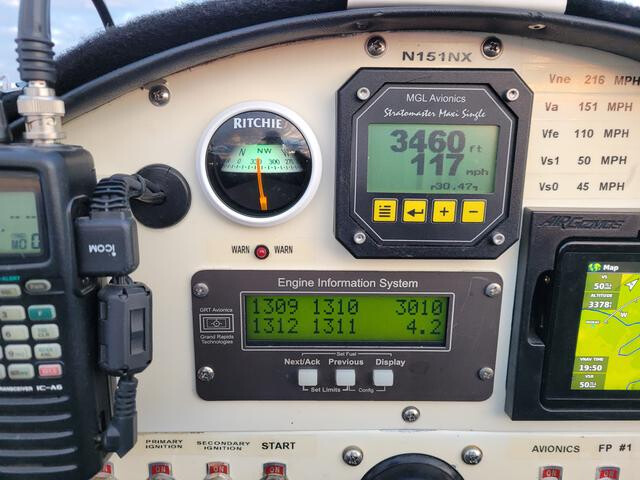
Here is a shot of the engine running on the VeeCU very close to my standard 3000 RPM cruise with the EGTs at about 1300.
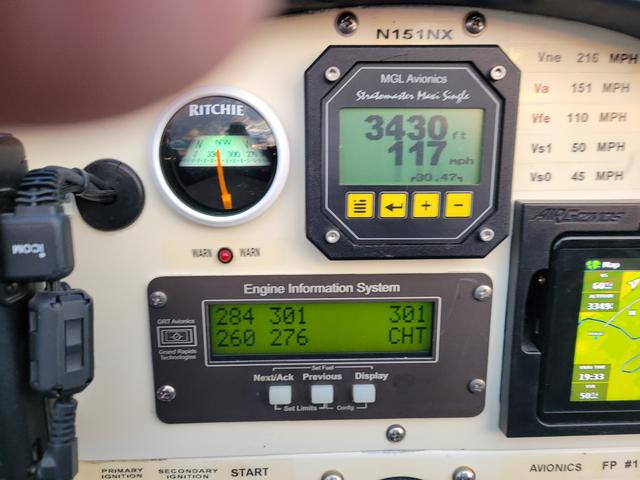
Here is a shot of the CHTs at that same setting.
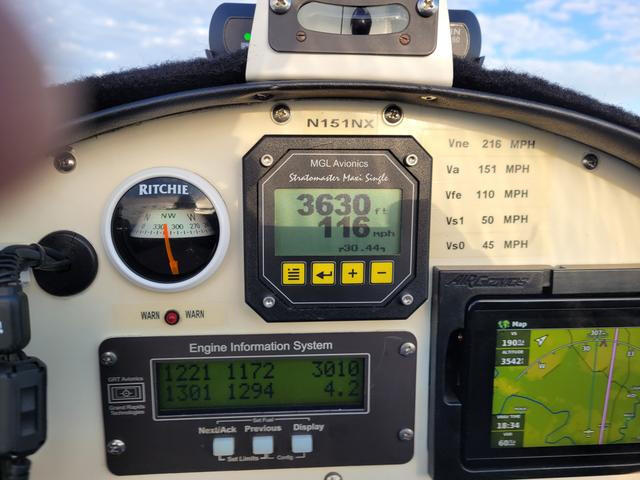
Here is a shot of the engine running on the AeroInjector very close to my standard 3000 RPM cruise with the AeroInjector leaned such that the hottest EGTs is about 1300. The VeeCU has no idea I’ve turned off the injectors and am fueling with the AeroInjector so the FF reading in this pic is not valid.
And here are the CHTs at the same setting.
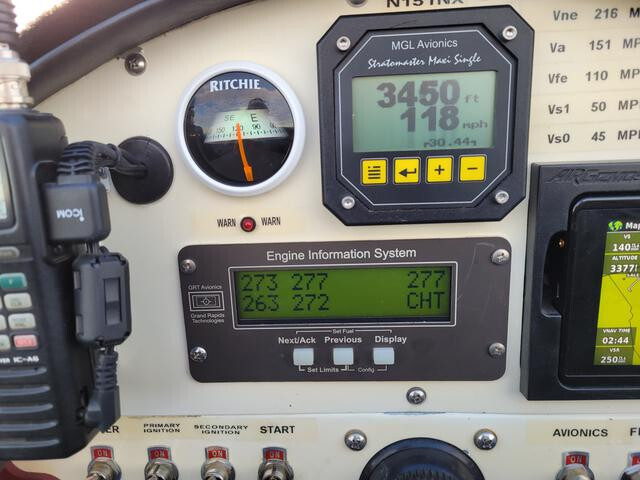
Keep in mind that I didn’t really linger and give the CHTs a chance to stabilize. Also, while trying to keep my CHTs in line while flying the Zenith carb, I installed a fairly aggressive cowl outlet.
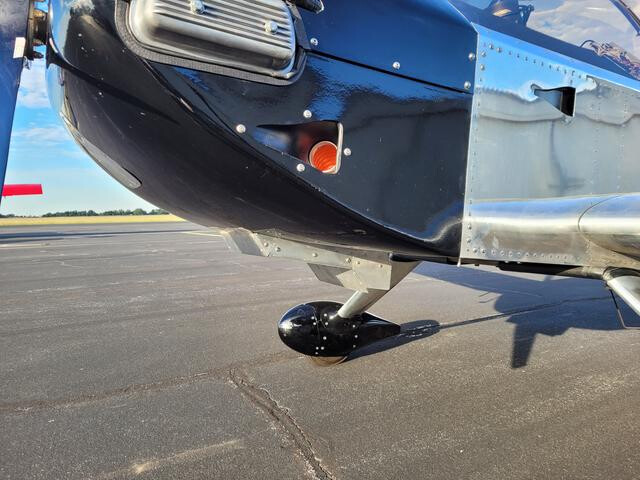
I may need to back off that some after all the dust settles. However, at some point, I’m going for the Holy Grail of 1250 EGT and 300 CHT on 94 octane auto fuel so we’ll see.
I’ll add that today was the first time my fuel totalizer and my calibrated dip stick disagreed on fuel level since part of the time I was fueling with the AeroInjector. It seems EFI will save me about 1 GPH of fuel.
More when I know More,
Wes
---
### Author:  [@Bryan\_Cotton](https://sonexpilots.org/u/Bryan_Cotton)
#### Post date: [October 18, 2026, 5:09pm UTC](https://sonexpilots.org/t/veecu-testing/6107/4 "2026-10-18T17:09:05Z")
Wes,
I was reading some of your old posts trying to figure out if you read EGTs with the VeeCU. I’m thinking the answer is no - it’s open loop WRT EGT but the GRT display is just telling you that the mixture is balanced. Is that correct?
---
### Author:  [@WesRagle](https://sonexpilots.org/u/WesRagle)
#### Post date: [October 18, 2026, 5:34pm UTC](https://sonexpilots.org/t/veecu-testing/6107/5 "2026-10-18T17:34:48Z")
Hi Bryan,
You are correct. The whole thing is open loop. In my opinion there are way too many pitfalls to closed loop. As soon as you go closed loop, you have to come up with heuristics to determine if the sensor you are relying on is working properly. I think it best to keep it simple and let the pilot make those decisions.
> [@Bryan\_Cotton](#):
>
> it’s open loop WRT EGT but the GRT display is just telling you that the mixture is balanced. Is that correct?
Yes, EGT is the best proxy we have for fuel mixture. It seems to work well for that.
Wes
---
### Author:  [@WesRagle](https://sonexpilots.org/u/WesRagle)
#### Post date: [October 22, 2026, 4:36pm UTC](https://sonexpilots.org/t/veecu-testing/6107/6 "2026-10-22T16:36:31Z")
Hi Guys,
I went flying again this morning. I’m just north of 10 Hours on the VeeCU now.
The questions on my mind this morning were:
1. Why are my CHTs so low?
2. Why are my rear CHTs constantly 30 Deg. F. lower than my front CHTs?
I measure my CHTs as close to the spark plug as I can, on the exhaust side of the plug.
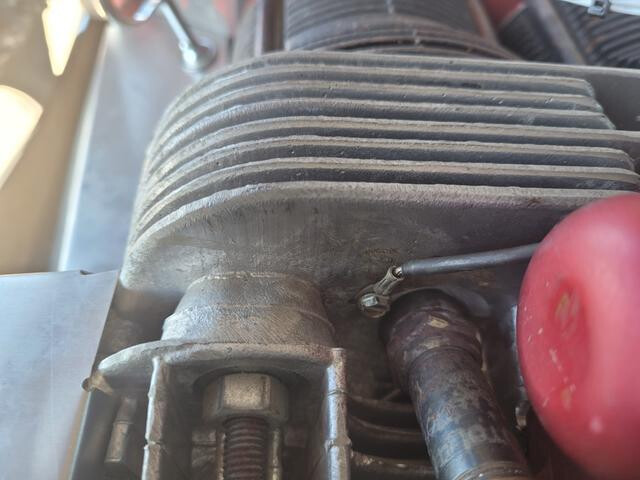
The answer to question number 1:
I’ll say some things that most folks already know, but for clarity I’ll say it anyway.
For gasoline to burn it has to evaporate/vaporize. To vaporize the fuel has to obtain what is called the “[latent heat of vaporization.]”([latent heat of vaporization of gasoline - Search](https://www.bing.com/search?q=latent%20heat%20of%20vaporization%20of%20gasoline&qs=n&form=QBRE&sp=-1&lq=0&pq=latent%20heat%20of%20vaporization%20of%20gasoline&sc=12-39&sk=&cvid=40F76E17B78B4BE58B184CD3ACC9A830))
For a large displacement VW, known to be stubborn when it comes to cooling, what better place to obtain that thermal energy than the cylinder heads. With fuel being injected directly into the intake port the cylinders are being evaporatively cooled at and around the valves.
The answer to question number 2:
The nagging problem of hot rear CHTs was solved twice. Once intentionally and once coincidentally. It was solved intentionally by balancing the front to back fuel distribution.
I’m using stock intake “logs”. All I did was install fuel injectors on the logs. With fuel injection, as air is drawn into the front cylinders, some of the fuel intended for the rear cylinders is scavenged. During the tuning process injection is biased toward the rear cylinders to compensate for this. So, that’s how the problem was “solved” intentionally.
Coincidentally, biasing the injection toward the rear cylinders means they receive more evaporative cooling.
This morning I did a WOT run at 3500 ft. I haven’t tuned at 3400 RPM, and I didn’t trim off the EGT spread, so the EGTs are starting to diverge a bit. Here is a shot of EGTs/RPM/FF and the CHTs at WOT with EGTs about 1300. My prop is a Prince 54/50. I think a 54/48 would be just about perfect.
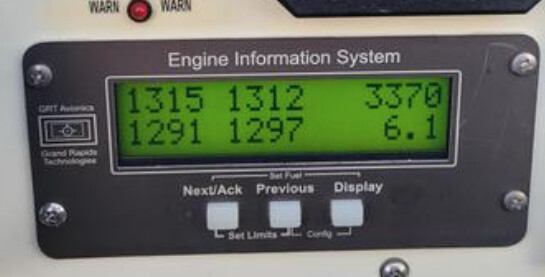
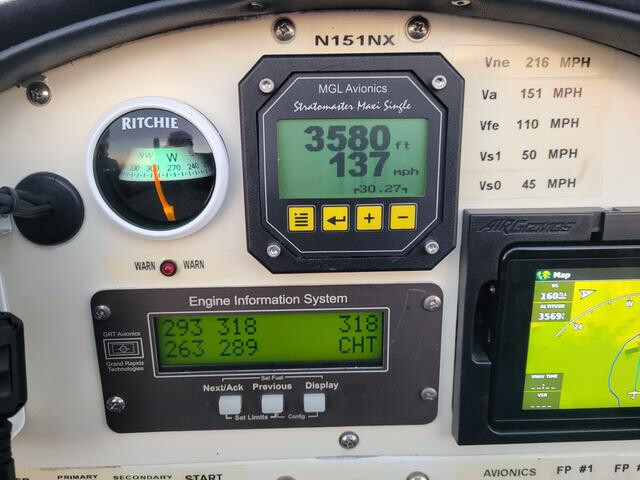
Every aspect of the VWs operation is improved with EFI. Except …
The latent heat of vaporization used to be supplied by cooling the intake air which I assume will result in a denser charge. So, I expect the AeroInjector will provide a slightly better peak power. I’ll eventually test that.
Wes
---
### Author:  [@Bryan\_Cotton](https://sonexpilots.org/u/Bryan_Cotton)
#### Post date: [October 22, 2026, 5:53pm UTC](https://sonexpilots.org/t/veecu-testing/6107/7 "2026-10-22T17:53:49Z")
> [@WesRagle](#):
>
> So, I expect the AeroInjector will provide a slightly better peak power.
Maybe somebody could bore out a 32mm AeroInjector a little, and make bigger induction tubes right to the ports.
Also is there a spare channel to control water injection?
My prop is a Prince 54/44. Seeing 3400+ WOT, and when my mixtures were balanced better front-rear I’d get 3600.
---
### Author:  [@WesRagle](https://sonexpilots.org/u/WesRagle)
#### Post date: [October 22, 2026, 6:58pm UTC](https://sonexpilots.org/t/veecu-testing/6107/8 "2026-10-22T18:58:07Z")
> [@Bryan\_Cotton](#):
>
> Also is there a spare channel to control water injection?
Water injection won’t provide any more O2 molecules. It might help the turbo boys with detonation, but I think for NA engine I’m set. I’ll leave all the hot rodding to you 🙂
Anything you can do to get more air into the cylinder will improve performance. I think the easiest thing you can do is build the largest displacement engine you can and fuel inject it.
I will eventually move my fresh air intake back to the front of the cowl and see if the AeroInjector complains. My cowl is starting to look like swiss cheese.
Wes
---
### Author:  [@WesRagle](https://sonexpilots.org/u/WesRagle)
#### Post date: [October 22, 2026, 7:14pm UTC](https://sonexpilots.org/t/veecu-testing/6107/9 "2026-10-22T19:14:18Z")
Just a little more on the cooling effect of EFI. I’ve noticed that the CHTs don’t change near as much as they used to with power changes. When changing power from cruise to WOT, keeping the EGTs about the same, it only increased CHTs by about 15 Deg. EFI really stabilizes CHTs. More fuel, more cooling. The same effect when I transition from cruise to climb.
I wish I was set up like Michael so I could record data. But I’m not.
Wes
---
### Author:  [@Dave\_Wolfe](https://sonexpilots.org/u/Dave_Wolfe)
#### Post date: [October 23, 2026, 12:57pm UTC](https://sonexpilots.org/t/veecu-testing/6107/10 "2026-10-23T12:57:16Z")
Regarding power claims:
EFI lets you safely consume cold air with no induction system icing risk. The stock sonex installation results in warm air being ingested which I think provides induction system icing protection at the cost of 100 ish rpms.
You might see some benefits if the ignition timing is advanced at lower manifold pressures. At altitude you could note the rpms using only the magnetrons.