Battery Bus - before the Battery Contactor
Posted: Mon May 16, 2022 8:22 am
by WilliamBatten
To the collective,
I’m a new builder - waiting on my kit. Thought I would begin the journey of designing my electrical system. I’ve read all of the posts on this forum - but still learning. I know Bob Nuckolls is the guru - currently reading through his book. Having said all of that - I am confused by his “Battery Bus” in these diagrams.
https://bandc.com/reference-library/
These are his Z-11 & Z-13 Electrical System diagrams.
My question is: It seems to me that the Battery bus, connected directly to the battery ahead of the Battery Contactor, with no switch - would drain the battery down while sitting in the hangar. I’ve noticed that he has used a similar design on several other of his diagrams.
What am I missing?
Bill
Re: Battery Bus - before the Battery Contactor
Posted: Mon May 16, 2022 9:06 am
by racaldwell
Bill,
This is not needed and, IMO, not desired, unless you have some particular device that requires a small amount of power to be on continuously. So you need to know what you will plan to install as to whether you need that battery bus. I would guess he says to use a fuseable link as the overcurrent protection. That is just a short piece of smaller wire in the circuit that will melt first in an overcurrent event.
Rick Caldwell
Xenos 0057 37 hrs in Ph 1
Re: Battery Bus - before the Battery Contactor
Posted: Mon May 16, 2022 10:10 am
by WilliamBatten
Thanks Rick.
Any other thoughts as to why Nuckolls includes this bus on several of his diagrams?
Bill
Re: Battery Bus - before the Battery Contactor
Posted: Mon May 16, 2022 10:24 am
by GordonTurner
My impression is that it is for a few non-critical items that you may want power to without turning in the master. Another example might be comm two, so that you can get Atis clearance, plus a light for entering at night, and per Bob’s notes a clock. The catch is that anything on this bus that is LEFT ON will of course drain the battery.
Gordon
Re: Battery Bus - before the Battery Contactor
Posted: Mon May 16, 2022 1:42 pm
by Rynoth
I have 2 things on my “hot” battery bus:
-
A small 1A fused wire to my multifunction display (I believe this helps from draining the internal button-cell battery in the unit)
-
A 7.5A fused 12v power socket in the cockpit. This socket has proven to be very useful, as it allows me easily plug in a 4A Battery Tender after every flight without having to open any panels or remove the cowling. During flight I can plug in a 12v-to-USB adapter if I need more plugs for powering gadgets (note that they will continue to drain the battery if left connected/charging after flight.) I have separate USB sockets that are on the avionics bus though so I don’t typically need to do this.
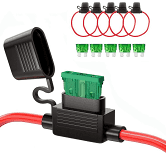
I didn’t actually create a “bus” for these 2 items. Instead I have an 18AWG wire attached to the battery side of the master contactor with an in-line fuse on the engine-side of the firewall to protect the wire, running to the 12v socket. From the 12V socket I attached a wire (with smaller inline fuse) to my MFD.
Re: Battery Bus - before the Battery Contactor
Posted: Mon May 16, 2022 2:10 pm
by WilliamBatten
Ryan,
Thanks for the insight - makes sense.
Bill
Re: Battery Bus - before the Battery Contactor
Posted: Mon May 16, 2022 7:57 pm
by Dave Wolfe
That is also intended for electrically dependent items needed to keep your engine running. Electronic ignition, fuel pumps, etc. By the time you go EFI, two batteries and their hot busses and a suitable architecture pretty much becomes a must from a failure analysis perspective.
Re: Battery Bus - before the Battery Contactor
Posted: Tue May 17, 2022 8:12 am
by WilliamBatten
Dave,
Can you elaborate a bit more? I am planning electronic ignition, fuel pump and TBI. However, I am planning a VFR only aircraft. What does the failure analysis look like in this scenario?
Thanks in advance,
Bill
Re: Battery Bus - before the Battery Contactor
Posted: Tue May 17, 2022 9:10 am
by Dave Wolfe
Its simple. If you remove a battery, will the engine still run? Battery failures are common, as are generator failures, open or short circuits, blown fuses, etc. When any of these occur, your engine must continue to run.
If your engine is equipped with dual ignitions, one if which does not requure external power to run, then the engine still runs when the electronic ignition is lost due to a battery failure, so you are OK safety wise and you can live with the simple electric system. If both ignitions require external power and are connected to a single batt, then a battery failure kills the engine. Thus, you need a redundant power source and appropriate electrical system to keep an ignition powered during all forseable electrical power failures.
The same goes for fuel pumps, efi systems, etc.
Re: Battery Bus - before the Battery Contactor
Posted: Tue May 17, 2022 9:26 am
by WilliamBatten
Thanks Dave - very helpful.
Bill
Re: Battery Bus - before the Battery Contactor
Posted: Tue May 17, 2022 1:56 pm
by OneTallShort
I would suggest that Bob Nuckolls has different wiring diagrams for electrically dependent aircraft (ECM) engines, specifically Z-19 with the “Engine Battery Bus”. In these designs, there is a backup battery bus (and contactor) in addition to the primary bus. Z-11 still has magnetos with optional (aux) electronic ignition.
More information on this bus can be found in The AeroElectric Connection Z-29 “Battery bus” diagram. This bus is not intended for electrically dependent ECM engine operation, but IS for the always on equipment or items that you want independent of the main battery contactor. The MGL EFIS “Keep alive” power that keeps the coin cell from being depleted is a perfect example of this use. The cooling pump circuit for the Turbo is another Sonex specific use, which is designed to run after shutdown and with the master off. And “bus” sounds more official than most of the typical field wiring installations of this equipment, but if you want electrical equipment on when the master (bus) is off, then it goes on this part of the circuit. If you think about automobile electrical design, this is extremely common…all that equipment that works when the key is off. Not saying that we should copy everything from auto design, but there are a lot of similarities.
It’s also important to understand that most Battery bus equipment has additional switches in the circuit. For example the Hobbs meter has a oil pressure switch on the ground side. The electronic ignition also has it’s own switch. Just because the equipment is directly off the battery before the contactor doesn’t mean that it can’t be shut off. The EFIS keep-alive circuit is probably the one exception to this rule, but it’s still fused.
I would also say that Bob’s point is that anything on this part of the circuit needs some type of protection close to the battery from a direct short…either a fusible link, or a fuse. Either will work. See The AeroElectric Connection page 10-4 where he discusses the use of fusible links. Using inline fuses on the firewall side is also pretty typical for these connections as Rynoth showed in his post.
I’d also suggest looking at the 001-510 B&C wiring diagram as a good simple starting point for a Sonex wiring diagram.
https://bandc.com/wp-content/uploads/2018/05/001-510_vfr_single_alt.pdf
I’m not sure if this is a Bob Nuckolls’ diagram, but it certainly reflects his other designs, and is a bit cleaner than the Z diagrams with updated B&C parts.
Gregg Short
Burbank, OH
Sonex N715SX